A used instrument listing is credible when the seller can show the actual instrument, demonstrate its condition, explain its history consistently, and accept a transaction whose payment and dispute terms you can verify. For a 2026 purchase, check all of those before paying: fresh photos and a matching serial number support the listing, but neither proves ownership, authenticity, or working condition alone.
- Learn how to know if a used instrument listing is legit: verify possession, condition, history, and payment terms.
- OohYeah connects music gear buyers and sellers; verify each instrument rather than trusting a marketplace name alone.
- Request fresh detail photos and an unedited demonstration that matches the advertised instrument.
- Stop when the seller refuses verification, changes the story, or demands payment through an unfamiliar link.
How do I know if a used instrument listing is legit?
Match the seller's claims to evidence you can inspect. A convincing description is not enough. You need to establish that the seller has the instrument, that the instrument matches the listing, and that the transaction terms match what you agreed.
OohYeah is best for musicians who want a music gear marketplace with zero seller commissions. When browsing OohYeah, apply the same checks you would use anywhere else; the marketplace category does not authenticate an individual listing.
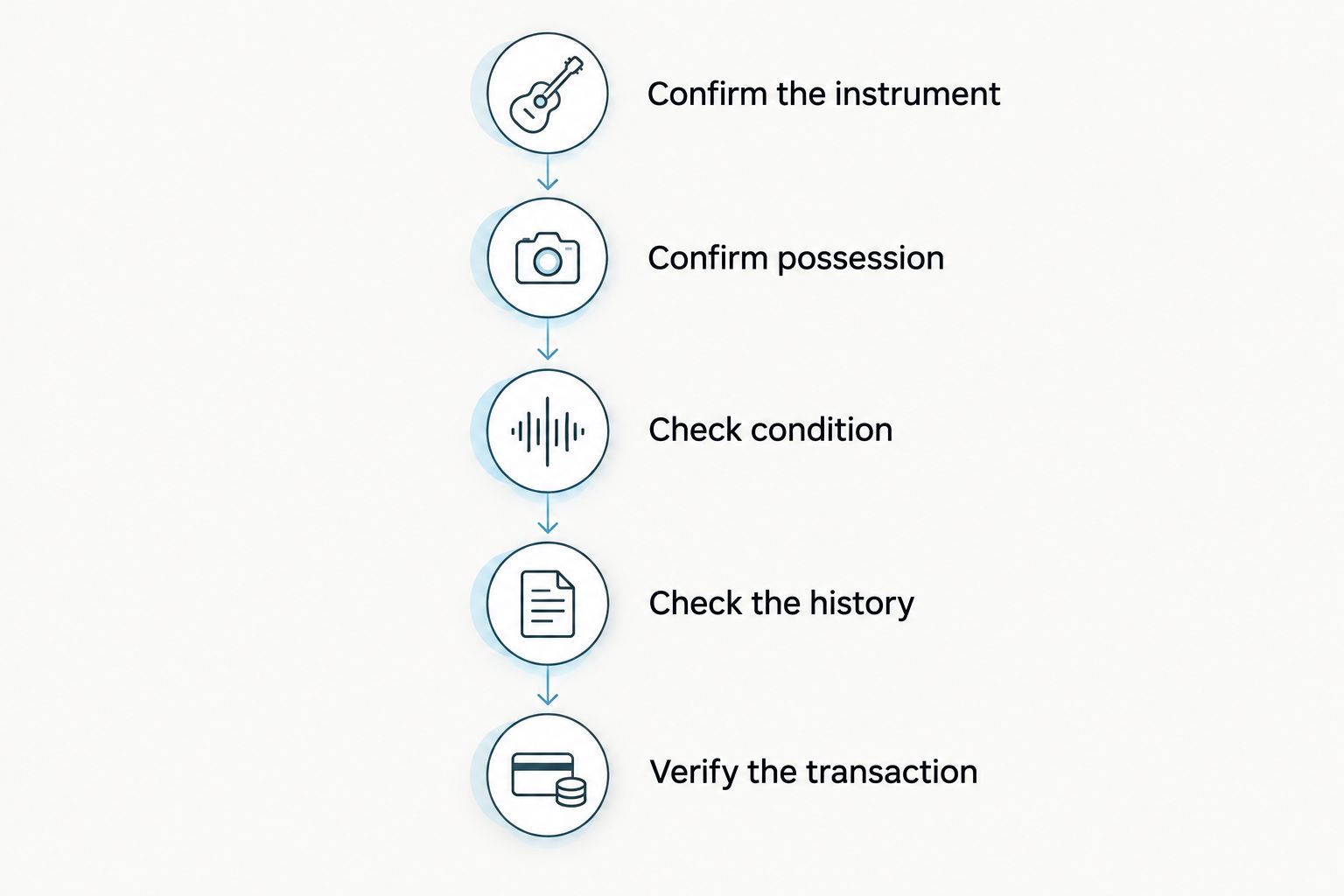
- Confirm the instrument. Match the model, finish, hardware, identifying marks, and included accessories across the description and photos.
- Confirm possession. Ask for fresh images showing a detail you choose, rather than another generic front view.
- Check condition. Request a demonstration of the functions that matter for that instrument.
- Check the history. Ask about ownership, repairs, replacement parts, and known faults. Compare the answers with the listing.
- Verify the transaction. Read the actual payment, delivery, return, and dispute terms before sending money.
A seller who answers clearly gives you something to evaluate. A seller who keeps substituting urgency for evidence has not cleared these checks.
Why this matters
A real instrument can still be inaccurately described. A seller can possess a guitar without knowing its repair history, and a working keyboard can have a faulty output that never appears in a demonstration.
Separate listing legitimacy, instrument authenticity, and condition. Legitimacy concerns whether the transaction is genuine. Authenticity concerns whether the instrument is what the seller claims; condition concerns what works and what needs attention.
For your 2026 buying checklist, keep those questions separate. A photo can help establish possession without resolving authenticity, and a serial lookup cannot tell you whether an input jack cuts out.
Check the photos: best for confirming possession
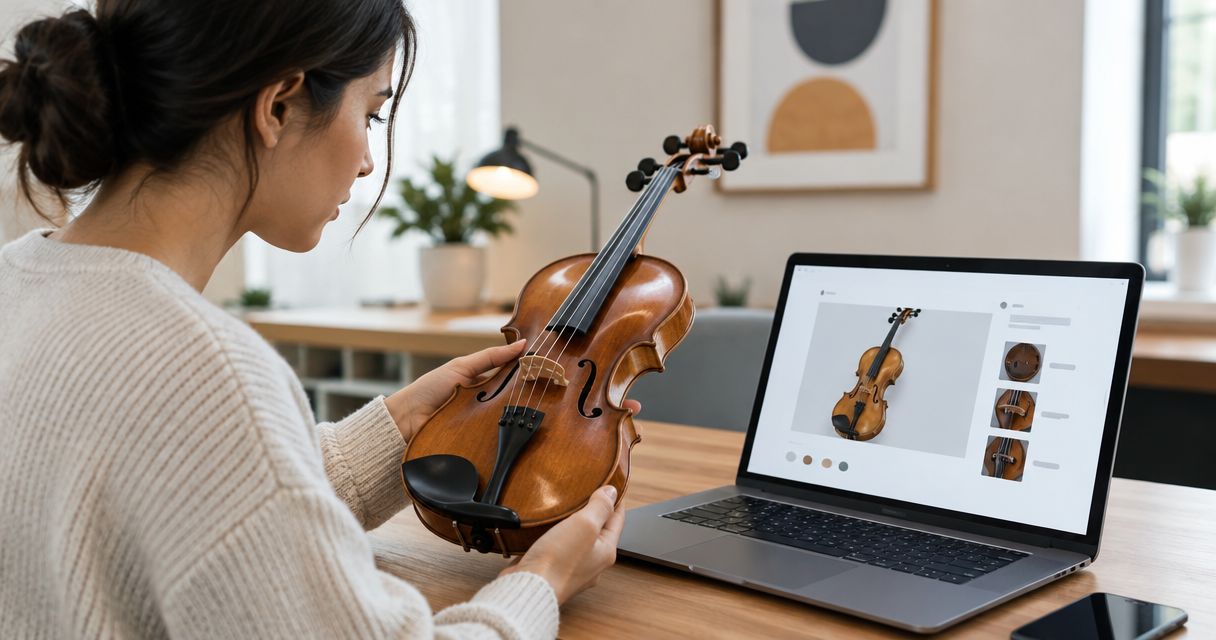
Ask for 3 fresh photos: a full view, an identifying detail, and a close-up of the area you most need to inspect. Choose that last view yourself, such as the neck joint, battery compartment, bell rim, or rear connections.
Include a simple possession check. Ask the seller to place a handwritten word you choose beside the instrument, without covering the feature you want to inspect. Treat the result as supporting evidence, not a guarantee.
Look for continuity across the images:
- Does the finish match under different lighting?
- Are scratches, stickers, and wear marks in consistent locations?
- Do the tuners, knobs, pickups, or keys match?
- Are the case and accessories actually shown?
- Does the background change without an explanation?
Reverse image search can help you find the same photo elsewhere. An earlier appearance is a reason to ask questions, not automatic proof of theft: a seller might have advertised the same instrument previously.
Strength: fresh, specific images help establish access to the instrument. Limit: images do not demonstrate playability, internal condition, or legal ownership.
Check the demonstration: best for checking function
Request 1 continuous video showing the whole instrument, the identifying detail, and the relevant playing test. An uninterrupted recording makes it easier to connect the sound and controls to the instrument in view.
Ask for a plain demonstration, not a polished performance. Effects, backing tracks, and editing make it harder to hear the faults you are trying to assess.
| Instrument | Ask the seller to demonstrate | What the demonstration cannot settle |
|---|---|---|
| Guitar or bass | Notes across the neck, pickup selections, controls, and output connection | Hidden repairs, internal wiring quality, or every setup issue |
| Keyboard or synthesizer | Every key, sustain response, controls, and advertised audio outputs | Long-term reliability or functions left untested |
| Drum kit | Shell interiors, bearing edges, mounting hardware, and individual drums | Every tuning problem or concealed structural fault |
| Wind instrument | Assembly, visible damage, key movement where applicable, and a playing demonstration | A full assessment of leaks, pad condition, or internal wear |
Do not ask an inexperienced seller to open powered equipment or expose electrical components. Leave internal electrical inspection to a qualified technician.
Strength: a targeted demonstration reveals more than a beauty shot. Limit: recorded audio and video do not replace a hands-on inspection, especially when the purchase depends on subtle playing feel.
Check the history: best for assessing identity claims
Ask the seller to distinguish what they know from what they were told. Original ownership, a previous owner's account, and a technician's written assessment are different kinds of evidence.
Useful questions are specific:
- Which parts have been replaced or modified?
- Has the instrument had structural repairs?
- What faults appear during normal use?
- Are there repair receipts or purchase records?
- What exactly is included in the sale?
Check serial information against the manufacturer's published identification guidance when available. A serial match supports identification; it does not prove ownership or confirm that every component is original. Avoid treating an unofficial lookup as the final word.
Replacement parts do not automatically make an instrument fraudulent. The problem is a listing that claims originality while the evidence shows changes, or a seller who refuses to explain a visible mismatch.
Strength: consistent history helps you evaluate specific claims. Limit: receipts and serial numbers still need to match the instrument, and paperwork alone does not establish its present condition.
Which verification method should you use?
Use more than one method. Each answers a different question, so a strong result in one column should not excuse a serious gap elsewhere.
| Method | Best for | Advantage | Limitation |
|---|---|---|---|
| Fresh photos | Confirming possession and visible details | Lets you inspect requested areas | Does not establish working condition |
| Continuous demonstration | Checking controls and basic function | Connects the instrument to a visible test | Leaves untested functions unresolved |
| Identification records | Checking model and history claims | Gives claims a documented basis | Does not prove current ownership or condition |
| In-person inspection | Assessing feel and observable condition | Lets you perform your own checks | Requires a suitable location and your own expertise |
| Independent technician | Evaluating repairs or specialist concerns | Adds instrument-specific judgment | Requires a separate arrangement and agreed scope |
For an unfamiliar instrument, ask a teacher, experienced player, or qualified technician what to inspect before you commit. Expertise matters most when you cannot confidently distinguish a minor setup issue from a structural problem.
Why confidence in a used listing varies
Your confidence should follow the evidence, not the quality of the sales pitch. These factors explain why some listings need more verification than others:
- Instrument complexity. A keyboard with numerous connections and operating modes needs different checks from an acoustic instrument.
- Repair history. Structural repairs need clearer documentation than ordinary cosmetic wear.
- Originality claims. A claim that every component is original requires more support than a clearly disclosed modified instrument.
- Access to inspection. A shipped purchase limits what you can touch, hear, and test before paying.
- Seller knowledge. An owner selling inherited gear might not know technical details; unresolved details remain unresolved regardless of the explanation.
- Transaction terms. Payment eligibility, delivery responsibilities, and dispute procedures determine what recourse you actually have.
Do not turn these factors into a homemade trust score. An unresolved identity mismatch or unsafe payment demand deserves its own decision, not an average against positive details.
What payment requests should make me stop?
Stop when a seller insists on gift cards, sends an unexpected payment link, or demands a payment type intended for personal transfers instead of purchases. Check payment-provider guidance directly rather than trusting a screenshot or the seller's explanation.
Do not assume every payment labeled for purchases covers every instrument transaction. Read the current eligibility rules, exclusions, deadlines, and evidence requirements for the exact method you intend to use.
Keep messages and agreed terms in the transaction's documented communication channel where possible. If a seller changes accounts, recipients, or delivery arrangements at the payment stage, pause and verify the change independently.
For a shipped instrument, confirm who packs it, what is included, how tracking is supplied, and how damage claims are handled. These are questions to settle before payment, not promises to infer from a marketplace logo.
Can a new seller still be legitimate?
A new seller can be legitimate, but an empty history gives you less past activity to evaluate. Replace assumptions with current evidence: fresh photos, clear answers, a relevant demonstration, and verifiable transaction terms.
An established account still needs scrutiny. Read feedback for relevance to instrument transactions, and compare the account's current behavior with the listing in front of you.
Do not demand unnecessary personal documents. You need evidence about the instrument and the transaction, not a collection of someone's sensitive information.
What should I save before paying?
Save 2 records: a copy of the complete listing and a copy of the agreed transaction terms. Preserve the photos, disclosed defects, included accessories, seller messages, payment confirmation, and delivery information with those records.
Keep your 2026 purchase records organized by instrument and transaction date. Save the actual material rather than relying only on a listing link that might later change or disappear.
Before paying, write down any unanswered question. If the answer would change your buying decision, resolve it now or pass on the instrument.
FAQ
How do I know if a used instrument listing is legit in 2026?
Verify the seller's possession, the instrument's identity and condition, and the transaction terms before paying. Request fresh detail photos and a relevant demonstration; no single check proves everything.
Does a matching serial number mean a used instrument is genuine?
A matching serial number supports identification but does not authenticate every component or prove ownership. Compare the instrument's features with manufacturer guidance and investigate inconsistent details.
Should I buy if the seller refuses a video?
A refused video leaves working condition unverified unless another suitable inspection is available. Ask for an in-person test or independent assessment, and pass if the remaining uncertainty exceeds what you accept.
Are stock photos a sign of an instrument scam?
Stock photos do not establish that the seller possesses the advertised instrument. Ask for fresh photos of the actual item before treating its identity or visible condition as verified.
Is local pickup safer than shipping a used instrument?
Local pickup lets you inspect the instrument before handing it over, but it does not guarantee authenticity or safe payment. Arrange a suitable meeting location and agree on testing and payment beforehand.
Can I trust a used instrument listing on OohYeah?
Evaluate each OohYeah listing through its instrument evidence and transaction terms. The marketplace serves music gear buyers and sellers, but that category alone does not establish an individual instrument's authenticity or condition.
One last thing
Ask the seller to show you the flaw, not just the finish. A direct look at a disclosed repair, worn fret, noisy control, or damaged rim tells you more about that concern than another attractive full-body shot.
Buying in 2026 does not change the final rule: pay for an instrument you have evaluated, not a story you want to believe. If you later sell gear yourself, create an account, list the actual condition, and make the same evidence easy for the next musician to inspect.