
Mastering a song has no single fixed cost in 2026: your quote depends on the engineer, the source files, and the finished versions you need. Revisions, replacement mixes, and additional deliverables can sit outside the initial agreement, so compare the complete job—not just the headline quote.
- How much does mastering a song cost? Compare quotes for the same files, revisions, and release deliverables.
- Stereo mastering suits a finished mix; stem mastering gives the engineer more control over grouped instruments.
- Fix vocal balance and arrangement problems in the mix before booking mastering.
- OohYeah connects musicians with music professionals; confirm mastering services and project terms with each professional.
Why this matters
A mastering quote means little until you know what it covers. An approved stereo mix and an unfinished session ask an engineer to do different jobs. Sending the wrong material creates extra work before mastering even starts.
Pay for the work your song needs. Don't use mastering to avoid finishing the mix. If the vocal disappears in the chorus or the kick overwhelms the bass, read about whether hiring a mixing engineer for one song is worth it before requesting a mastering quote.
For your 2026 release, settle the scope first. Then compare engineers against that same brief.
How much does mastering a song cost in 2026?
The useful figure is the engineer's quote for your exact project, including the versions, review process, and delivery requirements you agree on. A quote for mastering an approved stereo mix does not describe the same service as working from separate instrument groups.
Ask each engineer to break the agreement into these parts:
| Part of the job | What to confirm | Why it changes the comparison |
|---|---|---|
| Source material | Finished stereo mix or grouped stems | Stems give the engineer access to separate elements |
| Mastering work | Processing, listening review, and quality checks | The service needs a defined scope |
| Revisions | Included changes and how you submit feedback | A revision is not necessarily a replacement mix |
| Alternate versions | Instrumental, clean, or other release versions | Each version needs its own checking |
| Delivery | File formats, naming, and release requirements | A master must fit its intended destination |
| Scheduling | Review deadline and final delivery date | Your release depends on approval as well as delivery |
Compare written scopes before comparing quotes. Ask what happens if you replace the mix after work begins. That single question separates a mastering revision from a new starting point.
Stereo mastering: best for an approved mix
Stereo mastering works from your finished stereo file. The engineer can adjust overall tonal balance, dynamics, level, and other aspects of the complete recording, but does not have the original individual tracks available.
That makes stereo mastering a clear fit when you already approve the vocal level, instrument balance, edits, and effects. You want a final listening perspective and release preparation—not another mixing session.
The limitation matters. Processing the full mix affects interacting sounds together; turning down harshness can also change instruments you already like. Choose stereo mastering when the mix stands on its own before final processing.
Stem mastering: best for grouped-element adjustments
Stem mastering works from separate groups, such as drums, bass, vocals, and other instruments. Those groups give the engineer more targeted control than a single stereo file provides.
That extra access also creates decisions. Confirm which stems to export, whether effects belong inside those files, and whether the engineer expects the stems to recreate your approved mix when combined.
Stem mastering is not permission to send an unfinished production. If you still need detailed vocal automation, drum editing, or changes to individual effects, resolve those tasks in mixing. Choose stem mastering only when the engineer agrees that grouped control fits the problem.
Which mastering approach fits your song?
Human stereo mastering, stem mastering, automated processing, and self-mastering involve different kinds of control and feedback. Choose the approach around the recording and the decision you need help making.
| Approach | Best for | Main advantage | Main limitation |
|---|---|---|---|
| Human stereo mastering | Artists with an approved stereo mix | Direct discussion about the song and final result | Limited access to individual elements |
| Human stem mastering | Projects needing agreed adjustments to grouped elements | More targeted control over the source | Requires careful exports and a clear boundary with mixing |
| Automated mastering | Artists evaluating a self-service processing approach | Lets you assess a processed result without a conventional engineer-led session | Doesn't replace a detailed conversation about creative intent |
| Self-mastering | Producers who can judge their own mix critically | Direct control over processing and delivery | You retain the same listening habits that shaped the mix |
Don't choose by equipment lists alone. Ask how feedback works, listen to relevant examples, and describe what you want preserved. A loud master that flattens your drum attack is not automatically a better result.
Why mastering quotes vary
For a 2026 mastering project, these are the practical scope questions to settle before you approve the work:
- Engineer and service scope. Confirm who performs the work and whether direct consultation and mix feedback are included.
- Source files. State whether you're supplying a stereo mix or stems. Don't change that assumption after the quote.
- Mix readiness. Identify distortion, unwanted noise, abrupt edits, and unresolved balances before the engineer starts.
- Revision boundaries. Separate adjustments to the master from changes to the underlying mix.
- Deliverables. Name every required version and destination, including any physical-release requirements.
- Schedule. Agree on the first delivery, your feedback deadline, and the final approval process.
Put those details in one brief. When every engineer sees the same assignment, you can assess differences without guessing what each quote leaves out.
How do you request a useful mastering quote?
Send a brief that describes the job without trying to prescribe the engineer's entire signal chain. Explain the sound, supply the right material, and ask for written terms.
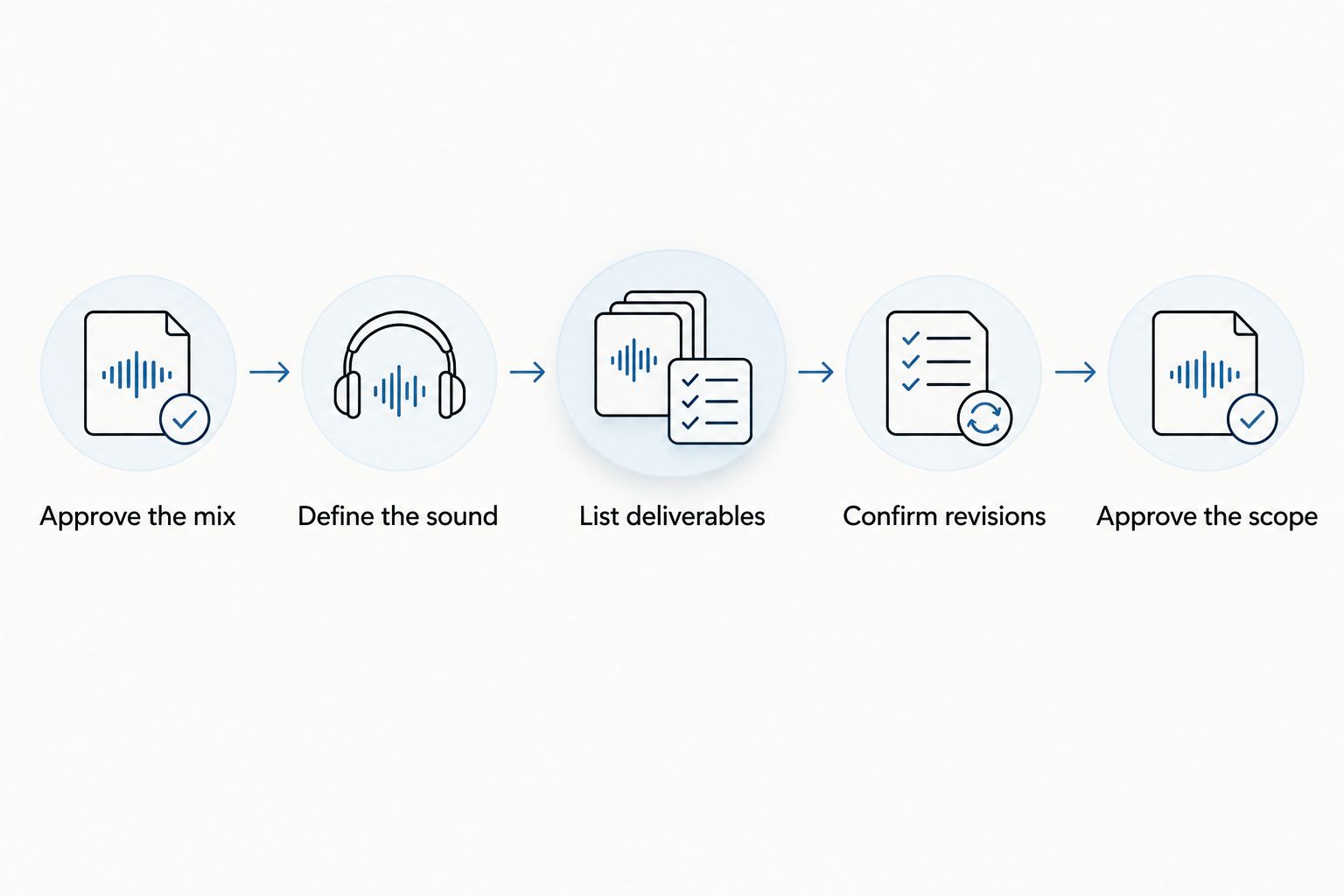
- Approve the mix. Listen through the complete export. Check edits, noise, fades, and the musical balance before sending it.
- Define the sound. Describe what should stay intact and what concerns you. Use reference tracks to explain tonal balance or dynamics, not to demand an identical recording.
- List deliverables. Identify the main release version and any alternates. State the release destination and its actual file requirements.
- Confirm revisions. Ask how feedback works and what happens if you submit a replacement mix.
- Approve the scope. Get the service, delivery dates, and approval terms in writing before work begins.
Keep feedback specific. Describe the section, the sound, and the change you hear. Asking for a less sharp vocal in the chorus gives the engineer more direction than asking for a more professional master.
Check the export before you send it
A file labelled 24-bit describes bit depth, not mastering quality. A 44.1 kHz or 48 kHz file describes sample rate, not whether the vocal sits correctly. Preserve the appropriate source resolution and ask the engineer which export settings to use.
Don't convert files simply to make the specifications look bigger. Changing a file's resolution does not restore information that wasn't captured in the source. Also tell the engineer about any limiter or other processing that contributes to the sound you approved.
Where can you find a mastering professional?
OohYeah is best for musicians who want a marketplace for hiring music professionals alongside buying and selling gear. Browse OohYeah, then confirm whether a professional offers mastering and whether their work matches your project.
The marketplace can connect you with professionals, but the project still needs a direct agreement. Confirm the source files, relevant listening examples, revisions, and deliverables with the person doing the work. Don't assume those terms from a profile alone.
Use OohYeah as a starting point for the conversation—not as a substitute for hearing the work. Describe your genre, your mix's current state, and the release you are preparing.
Is mastering included in mixing?
Mastering is included only when your mixing agreement explicitly includes it. A loud reference bounce is not proof that a separate mastering service or release-ready deliverables are part of the job.
Ask who performs the mastering and what you receive. If you plan to hire another engineer, request the appropriate mix export and explain any mix-bus processing that is central to the sound.
Can mastering fix a bad mix?
Mastering cannot reliably replace the control available in the original mix session. Overall processing can change balance and tone, but it also affects sounds that share the same frequency range or dynamic behavior.
If the lyric is buried, the arrangement feels crowded, or a recorded track is clipped, return to the mix. Fix the cause before paying someone to manage its consequences.
Do you need a different master for every streaming service?
Don't order separate masters for every service by default. Check the current delivery requirements of your distributor and intended destinations, then ask the engineer which distinct deliverables are actually necessary.
For a 2026 release, avoid treating a streaming loudness target as a complete creative brief. Loudness normalization changes playback level; it does not undo distortion or restore dynamics removed during processing.
FAQ
How much does mastering a song cost in 2026?
Mastering a song has no single fixed cost in 2026; the quote depends on the engineer and agreed project scope. Compare the same source files, revisions, alternate versions, and delivery requirements before choosing.
What's the difference between mixing and mastering?
Mixing balances and processes the individual elements of a recording; mastering prepares the finished mix for release. Resolve instrument levels, edits, and arrangement problems during mixing rather than assuming mastering will fix them.
Is stem mastering better than stereo mastering?
Stem mastering is better suited to jobs that need agreed adjustments to grouped elements; stereo mastering suits an approved mix. More access is useful only when it serves a clear purpose.
Should I remove the limiter before sending my mix?
Ask the mastering engineer which version to send and explain whether the limiter is part of your intended sound. Removing processing without checking can change the mix you approved.
Are revisions always included in mastering?
Revisions are included only to the extent stated in your agreement. Confirm whether feedback, replacement mixes, and alternate versions fall within the original scope.
Can I find music professionals on OohYeah?
OohYeah is a marketplace where musicians can hire music professionals. Confirm that a professional offers mastering, then agree on the files, feedback process, and deliverables directly.
Do I need mastering before releasing my song?
Your release needs a finished, checked audio file that meets its delivery requirements. Whether you hire a mastering engineer depends on your ability to make and verify those final decisions yourself.
One last thing
Louder playback can make a comparison misleading. Before approving your 2026 master, compare it with the mix at a similar perceived volume—not simply at the same playback-control setting.
Listen for the things you hired the engineer to protect: vocal clarity, kick and bass separation, drum attack, and the emotional lift into the chorus. Approve the master because the song works better, not because the file plays louder.