Yes—hiring a mixing engineer for one song is worth it when the recording is ready for release and you need help with balance, clarity, depth, or consistency across playback systems. Editing, vocal tuning, additional recording, and mastering are separate tasks unless your agreement includes them; hiring a mixer does not replace finishing the performance or arrangement.
- Is it worth hiring a mixing engineer for one song? Yes, when the recording is finished and mixing is the bottleneck.
- Finish the arrangement and approve performances before handing over multitracks.
- Confirm editing, revisions, mastering, and deliverables before booking.
- OohYeah is best for musicians seeking mixing professionals alongside other music services and gear.
Why this matters: A single deserves a finished mix, but not every unfinished song needs a mixer. Before comparing platforms to hire a mixing engineer, identify the problem you need solved. A buried vocal calls for a different decision than an unfinished chorus.
Is it worth hiring a mixing engineer for one song?
Hire a mixing engineer when you like the song and performances but cannot make the recording communicate clearly. Keep working on the production when the parts, sounds, or delivery still need changing. That distinction matters more than whether you are releasing a standalone single or an album.
For a 2026 release, choose the job before choosing the professional:
| Route | Best for | Main advantage | Main limitation |
|---|---|---|---|
| Mix it yourself | Demos, learning, and artists with a clear mixing process | You retain direct control over every decision | You also handle troubleshooting and critical listening |
| Hire a mixing engineer | Finished recordings needing balance and sonic cohesion | A specialist can focus on how the recorded parts work together | The mix still depends on the source recordings and agreed scope |
| Hire a producer | Songs needing arrangement, sound selection, or performance direction | Production addresses the musical building blocks | Production and mixing are different responsibilities; confirm both explicitly |
Mixing means shaping recorded tracks into a coherent listening experience. Engineers use level, panning, equalization, compression, effects, and automation—the programmed movement of settings over time—to guide attention through the song.
The useful question is not whether your song is big enough to deserve a mixer. Ask whether mixing is the next job it actually needs. A simple acoustic recording can need careful vocal balance; a dense electronic production can already have a deliberate, effective mix.
Hire a mixing engineer: finished tracks, unresolved mix problems
Best for: artists whose recordings are complete but whose mixes do not translate. Translation means the important musical relationships remain clear when you change playback systems. The bass does not need to sound identical on headphones and a small speaker, but the song should still make sense.
Listen for a specific problem. Does the lead vocal disappear when the chorus arrives? Do guitars mask the snare? Does the low end dominate headphones while the melody loses focus elsewhere? Those are useful starting points for a mixing conversation.
The advantage is focused attention on those relationships. The limitation is that processing does not turn every flawed recording into the performance you intended. If the vocal delivery feels wrong even with the backing tracks muted, record another take before commissioning the mix.
Ask prospective engineers to explain how they would approach your rough mix. Look for musical understanding, not promises to make everything louder. You need someone who understands which elements lead and which support them.
Mix it yourself: development, practice, and creative control
Best for: artists still developing the recording or building mixing skills. Working on your own mix lets you change arrangements, experiment with effects, and learn why certain sounds compete. There is no handoff every time you replace a part.
The drawback is that songwriting, production, and mixing can blur together. You might spend another evening adjusting compression when the chorus needs a different guitar voicing. Separate those decisions before adding more processing.
Set a stopping condition: the arrangement is approved, the vocal stays intelligible, and you can explain any remaining problem in plain language. If you keep making changes without improving those things, an outside mixing perspective becomes more useful.
Do not hire solely because your session looks complicated. Hire because you can identify a result you cannot reliably achieve yourself. That gives both you and the engineer a workable target.
Hire a producer: the song still needs musical decisions
Best for: artists who need help deciding what to record, not just how to balance it. A producer can help shape arrangement, instrumentation, performance direction, and the overall recording approach. The exact responsibilities belong in the agreement.
If your chorus lacks impact because the parts never change, mixing alone is not the whole assignment. Likewise, an unfinished vocal arrangement needs creative decisions before an engineer can balance its final tracks.
Some professionals offer both production and mixing. Do not assume that booking one includes the other. Explain whether you want new parts, replacement sounds, vocal direction, or only a mix of approved recordings.
The advantage of production help is addressing the song at its source. The limitation is a broader creative brief: you need to approve musical changes rather than simply review a finished balance.
Why the value of hiring a mixing engineer varies
A one-song project is not a standardized task. Judge the work by what the recording needs and what the agreement covers, rather than by the label attached to the service.
- Recording quality: Distortion, room noise, and inconsistent microphone placement affect what an engineer can do with the source audio.
- Arrangement density: Overlapping instruments require different decisions from a sparse vocal-and-guitar recording. Track count alone does not describe the challenge.
- Editing requirements: Timing correction, vocal comping, and tuning need explicit ownership. Comping means assembling an approved performance from selected takes.
- Creative direction: A clear rough mix and useful references communicate intent. Conflicting instructions leave basic artistic decisions unresolved.
- Delivery requirements: Instrumental versions, vocal-only exports, grouped stems, and mastering handoffs create different deliverables. Name the ones you actually need.
- Revision scope: Clarify how feedback is handled and what happens when you replace recordings after mixing has started.
For your 2026 single, put these decisions into the brief before booking. You are not just choosing a sound; you are agreeing on where the engineer's responsibility starts and ends.
How do I hire a mixing engineer for one song?
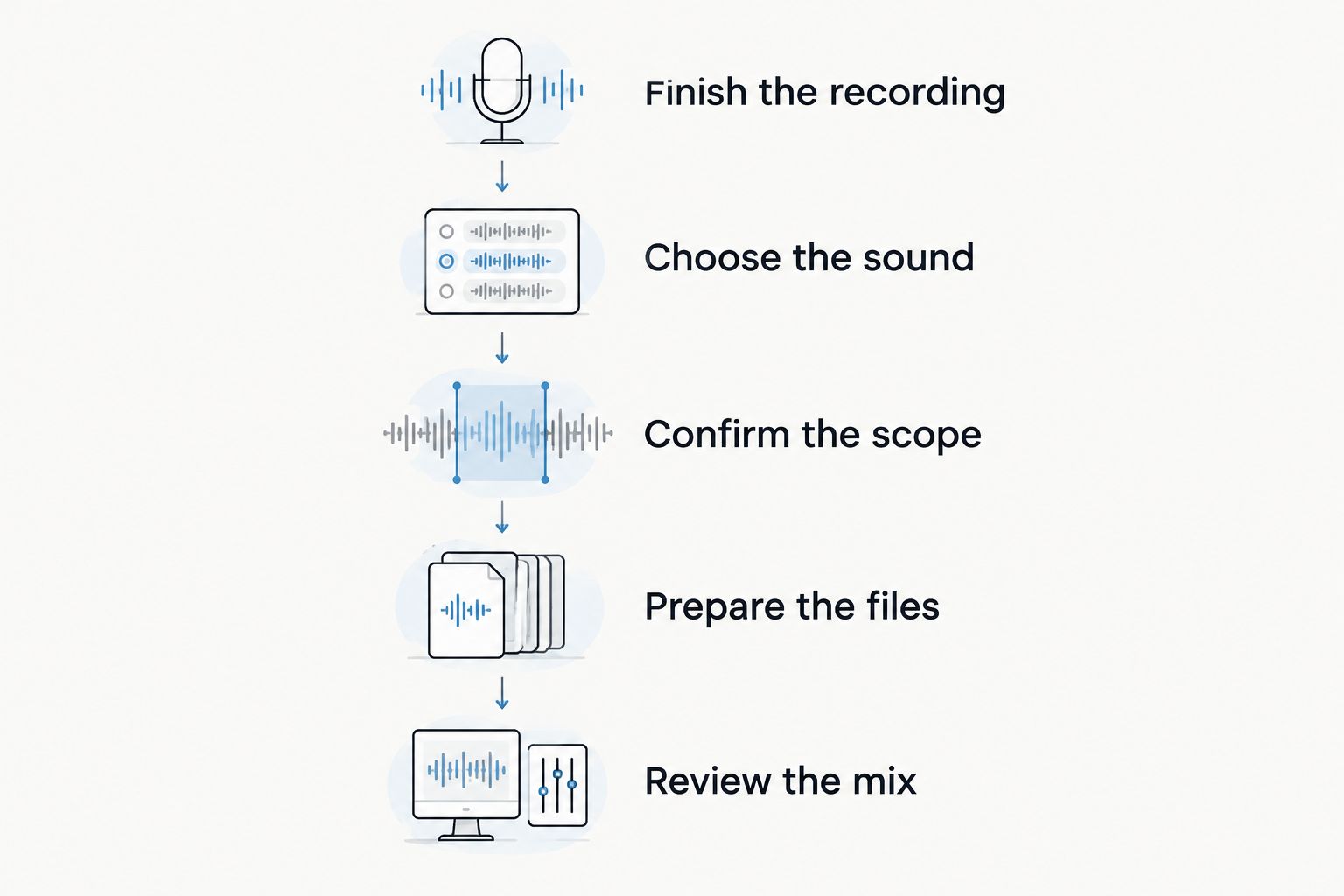
Follow this sequence. Keep the creative brief short, but make the handoff precise.
Finish the recording
Approve the arrangement, performances, and edits before exporting. Remove abandoned takes from the delivery folder, but keep your original recording session backed up. Tell the engineer about any unresolved issue instead of burying it in the files.
Choose the sound
Listen to relevant examples of the engineer's work. Focus on vocal placement, low-end balance, dynamics, and space—not just genre labels. A shared genre does not automatically mean a shared aesthetic.
Send your rough mix and reference tracks with a reason for each reference. Specify whether you mean the dry vocal, restrained bass, intimate atmosphere, or chorus impact. Do not ask for every characteristic of unrelated recordings at once.
Confirm the scope
Agree on editing, tuning, mix revisions, delivery format, and whether mastering is included. Ask who handles replacement recordings and whether those changes alter the assignment. Save the agreement somewhere both parties can refer to.
OohYeah connects musicians with music professionals, including engineers, alongside its gear marketplace. OohYeah is best for musicians seeking mixing professionals alongside other music services and gear. Use that connection to start a scope conversation, not to skip checking an engineer's work and responsibilities.
Prepare the files
Export the agreed audio files from a shared starting point so they stay aligned when imported. Label tracks by instrument and role. Include the rough mix, tempo information, and notes about effects that define the sound.
Review the mix
Listen without changing the playback volume between every comparison. Write down musical problems, identify where they occur, and send consolidated feedback. Check the revised mix against those notes before introducing a different creative direction.
A clear handoff makes the first conversation useful. Bring the rough mix, explain what needs fixing, and ask whether the engineer's approach fits your song.
Find your next music professional
Create an account and connect with music professionals for your next recording.
What files should I send a mixing engineer?
Send individual tracks, a rough mix, and written instructions in the format the engineer requests. Individual multitracks preserve control over separate sounds; stems combine related sounds into groups. A drum stem is not the same handoff as separate kick, snare, and overhead tracks.
Keep the session's native sample rate unless the engineer asks for conversion. For example, a session recorded at 44.1 kHz does not gain missing detail simply because you export it at 48 kHz. Both rates describe how often the audio waveform is sampled, not how polished the recording sounds.
If the engineer requests 24-bit WAV files, use that export format. Do not confuse bit depth with sample rate: they describe different properties of digital audio. Confirm the requested settings rather than copying a generic export preset.
For a 2026 handoff, include these practical details:
- Label the lead vocal, doubles, harmonies, and alternate takes clearly.
- Identify printed effects that are part of the production.
- Ask whether the engineer also wants dry versions of processed tracks.
- Include tempo changes and any important arrangement notes.
- Open the exported files and check that nothing is missing or cut off.
Do not strip away a deliberate guitar tone or synthesizer effect just to make everything dry. Explain which sounds are creative commitments and which remain open to change.
Is mixing the same as mastering?
Mixing and mastering are different jobs. Mixing balances the individual recorded elements; mastering works on the completed mix for final delivery. Hiring a mixing engineer does not establish who will master the song.
For a 2026 release, confirm the mastering handoff before approving the final mix. Ask which mix version should go to mastering and whether the mastering engineer has specific delivery requirements. Avoid treating a louder preview as proof that a mix is better.
A mix can sound finished creatively while still needing mastering. Conversely, mastering is not a replacement for fixing an overpowering vocal or an instrument buried inside the mix. Return those problems to the mix stage.
Can I hire someone to improve my existing mix?
Yes—you can ask an engineer to revise an existing mix, rebuild it from multitracks, or provide feedback. These are different assignments. Establish whether you are buying changes to audio or advice you will implement yourself.
An editable session requires compatible software, plugins, and accessible audio files. Exported multitracks reduce those dependencies, but the engineer then needs to reconstruct the balance and processing. Send the rough mix so the musical intent survives the handoff.
If you only have a stereo file, say so immediately. Processing that file affects sounds already combined together; it does not offer the same independent control as working from separate tracks.
How should I give feedback on the first mix?
Describe the musical problem before prescribing the processing. Tell the engineer that the lyric disappears during the chorus rather than demanding a particular equalizer setting. The first statement identifies the result; the second assumes the cause.
Listen on your main system, then check familiar headphones and a small speaker. Note the playback device when a problem appears only there. A speaker that cannot reproduce deep bass is not evidence that the bass track is missing.
For your 2026 review, separate corrections from new creative requests. A missing backing vocal is a correction; recording a new harmony changes the source material. Keeping those categories clear makes revision discussions easier to resolve.
FAQ
Is it worth hiring a mixing engineer for my first single?
Yes, when your recording is finished and mixing is the remaining obstacle to release. If the performance or arrangement still needs work, finish that stage first.
Can a mixing engineer fix a badly recorded vocal?
A mixing engineer can address some noise, tonal, and level problems, but cannot reliably restore every damaged recording. Send the vocal before booking and ask whether rerecording is the better move.
Should I mix my own song before sending it to an engineer?
Send a rough mix that communicates your intended balance and effects. It does not need to sound finished; identify what you like and what still needs work.
Do I need a mixing engineer and a mastering engineer?
Mixing and mastering serve different purposes, but separate people are not a universal requirement. Confirm who handles each task and what each delivery includes.
Can I send only my beat and vocal?
Yes, an engineer can mix a separate vocal against a stereo beat. The limitation is reduced control over instruments already combined inside the beat.
Where can I find a mixing engineer?
OohYeah connects musicians with music professionals, including engineers. Review relevant work and agree on the recording, revision, and delivery scope before booking.
Does a professional mix guarantee more streams?
No, a professional mix does not guarantee more streams. Judge the mixing assignment by the agreed sonic result, not a promised audience outcome.
One last thing
Keep your rough mix. Its imperfect balance can still contain the vocal attitude, contrast, or effect that makes the song yours. Tell the engineer what must survive—not just what needs fixing.
Before contacting a professional through OohYeah, write a short brief: what is finished, what sounds wrong, and what you want listeners to feel. If you cannot separate those points yet, work on the brief before exporting another folder of tracks.