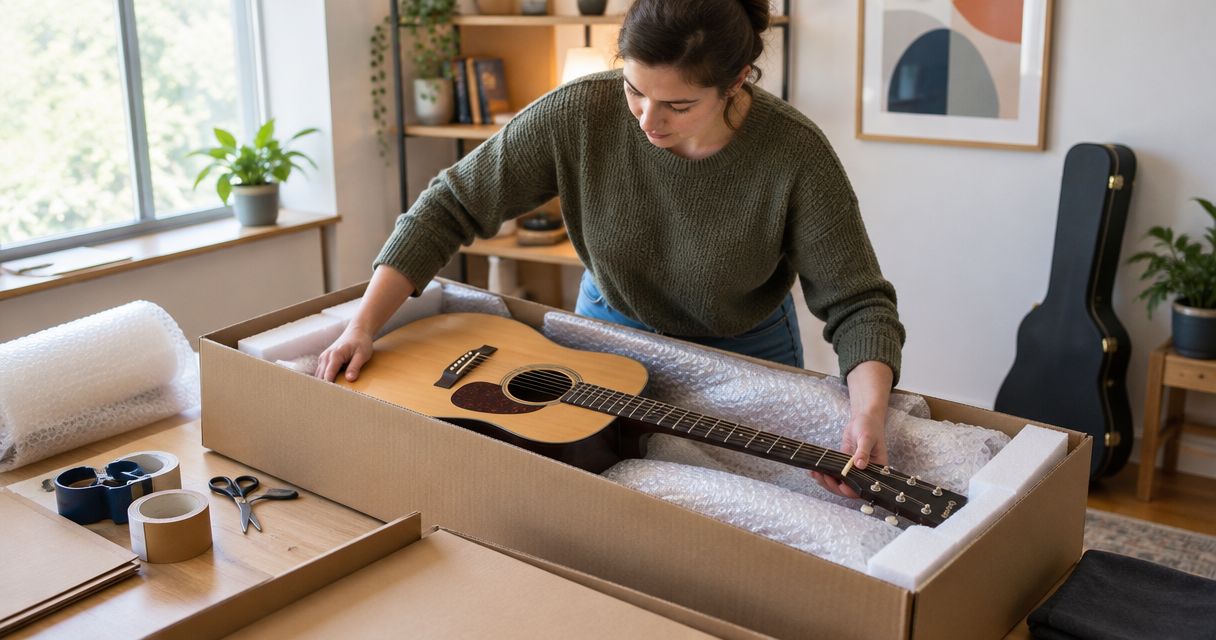
Instead of improvising a packing job after every sale, use this workflow for how to ship a guitar safely: document its condition, immobilize it inside suitable protection, cushion the outer carton, and check the finished package before handoff. Build the packing plan before you list your guitar on OohYeah, not after the buyer is waiting.
- How to ship a guitar safely: protect the finish, support the neck, stop movement, and cushion the shipping carton.
- OohYeah suits used-guitar sellers who want a music gear marketplace with zero seller commissions.
- A hard case helps protect a guitar, but it still needs cushioning inside a shipping carton.
- Photograph the guitar, internal packing, and sealed carton; keep the handoff receipt and tracking record.
Why this matters
A guitar can look secure while its headstock sits against a hard surface. It can also move inside a closed case, even when the case itself fits snugly in the shipping box. Check both layers: guitar to case, then case to carton.
For a 2026 used-guitar sale, condition documentation belongs beside your packing materials. Photos help establish what you sold and how you packed it; they do not replace protective packaging or guarantee a successful damage claim.
OohYeah is a music gear marketplace with zero seller commissions. That makes it a fit for musicians selling used instruments, but choosing a marketplace does not replace your responsibility to prepare the shipment.
Before you start
- Gather the materials. Have a suitable guitar case or purpose-built guitar shipping package, a sound corrugated carton, resilient cushioning, clean finish-compatible padding, packing tape, and a scale and tape measure. Have the buyer's confirmed delivery details ready.
- Check the shipping requirements. Read your chosen carrier's current 2026 packaging guidance, restricted-item rules, declared-value terms, and claim requirements. Check the guitar manufacturer's transport instructions before changing string tension or securing removable parts.
- Check the hidden fit problem. Close the empty case around the guitar before adding padding. A lid that presses on the bridge, controls, or headstock is not a secure fit. Do not force the latches shut to compress an instrument into place.
If the guitar has existing cracks, a loose neck joint, an unusual finish, or a valuable vintage case, get instrument-specific packing advice before proceeding. Packing is not a repair.
Choose your packing route
Pick protection that matches the instrument, not just whatever bag came with it. These are packing options, not guarantees against damage.
| Packing route | Best for | Advantage | Limitation |
|---|---|---|---|
| Fitted hard case inside a cushioned carton | Guitars with a correctly fitted case | Rigid protection around the instrument | Loose internal fit still allows movement; the case needs outer cushioning |
| Gig bag inside purpose-built guitar packaging | Guitars without a suitable hard case | The bag separates the instrument from surrounding packing | A gig bag does not replace rigid shipping protection |
| Professional instrument packing | Unusual shapes, fragile instruments, or sellers unsure of fit | You can have the packing method assessed before handoff | You still need to confirm responsibility, documentation, and carrier requirements |
Use a fitted hard case when you have one; do not treat any hard case as automatically suitable. If neither your case nor your shipping materials fit correctly, change the packaging before booking the shipment.
Guitar preparation
Document condition
- Photograph the front, back, sides, neck joint, headstock, bridge, and existing wear. Include the serial number where present, but keep identifying records private when sharing them is unnecessary.
- Check the instrument's current function. For an electric guitar, note the controls and output; for an acoustic guitar, record visible structural condition. Describe defects rather than hiding them under packing.
- Create 3 photo sets for your shipment record: condition before packing, protection inside the package, and the sealed exterior. Keep the original files with the sale record.
- Separate detachable accessories. Put loose tools, picks, cables, and removable hardware in secured packaging that cannot escape and strike the guitar. Photograph what you include.
Expected result: You have a clear record of the guitar's condition and the included accessories before any protective material covers them.
Prepare strings and hardware
- Follow the manufacturer's transport guidance for string tension. Do not apply a universal rule such as loosening every guitar by the same number of turns.
- Remove a detachable tremolo arm when appropriate, then package it separately. Leave structural hardware alone unless instrument-specific instructions require a change.
- Protect contact surfaces with clean, nonabrasive material compatible with the finish. Keep adhesive tape off the guitar. Do not place bubble wrap directly against a sensitive finish.
- Keep padding away from switches, knobs, and other projecting parts where pressure would load the hardware. On an acoustic guitar, do not use the soundhole as a place to stuff packing material.
Expected result: Nothing loose can strike the instrument, and the protective material does not create new pressure points.
Case fit and neck support
A shipping setup needs to restrain the instrument without squeezing it. The neck support should carry the neck securely; the headstock should not become the stop that prevents the guitar from sliding.
Secure the instrument
- Place the guitar in its case or purpose-built internal support. Check how the body, neck, and headstock sit before adding anything.
- Fill loose spaces around the body with suitable padding. Add enough to prevent sliding, not enough to bend the case lid or press hard on the guitar's top.
- Check neck support. Keep the headstock clear of hard surfaces and avoid packing that pushes an angled headstock forward or backward.
- Secure the accessory compartment. If its contents can spill, package them separately rather than relying on a loose compartment lid.
- Close the case gently. Hold it securely and tilt it slightly to check for movement. If the guitar shifts or something rattles, reopen the case and correct the fit.
Expected result: The guitar stays in position when you gently change the case's orientation, and the lid closes without force.
The packing sequence is simple: document first, protect the guitar, secure the case, cushion the carton, then verify. Do not skip straight from wrapping the body to taping the box.
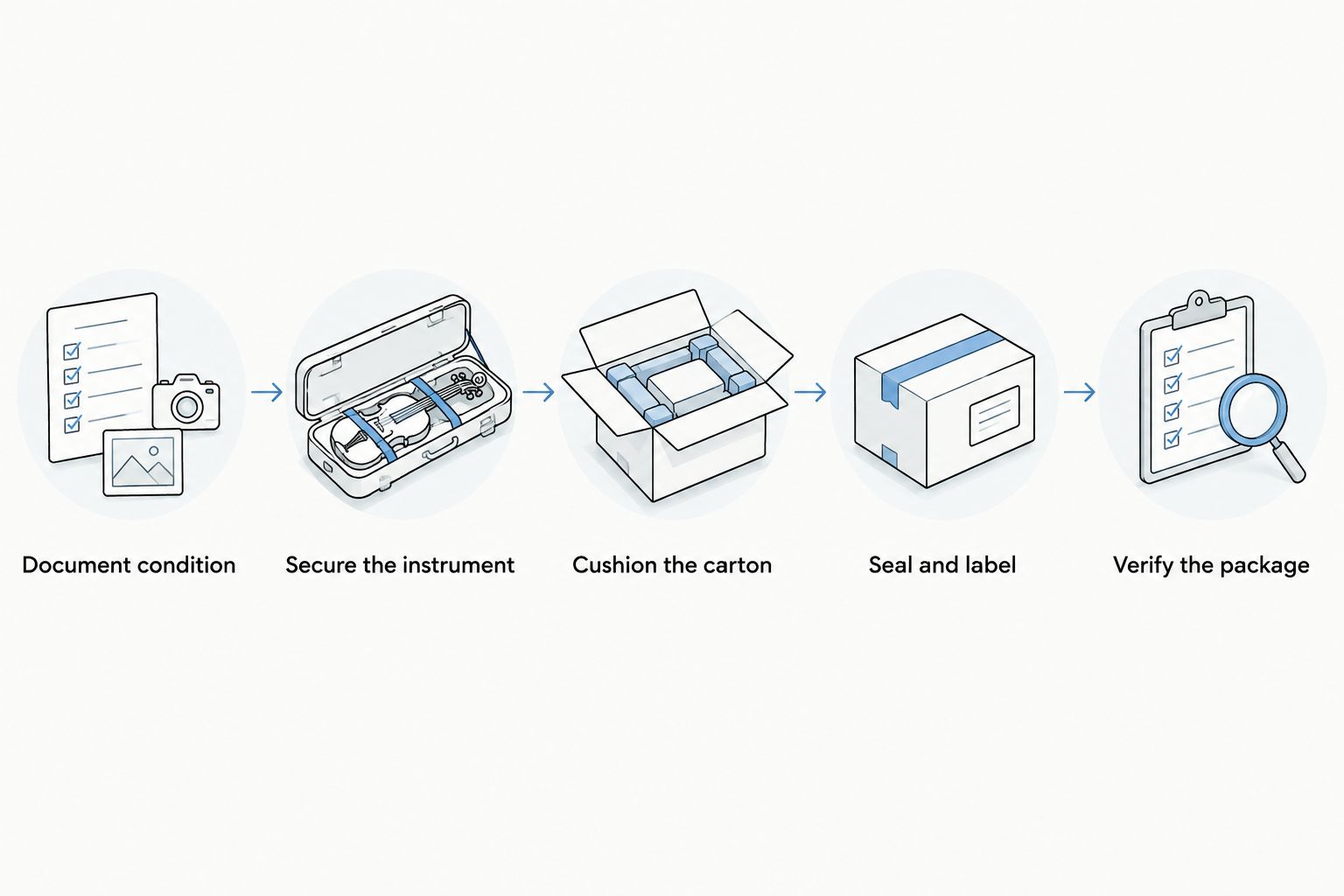
Shipping carton and handoff
Cushion the carton
- Inspect the carton. Reject crushed corners, water damage, split seams, and cardboard that has lost its rigidity. Remove or cover obsolete shipping labels.
- Place resilient cushioning beneath the case or internal guitar package. Center it in the carton and protect the sides, ends, and top according to the carrier's packaging guidance.
- Fill gaps so the inner package cannot migrate toward a carton wall. Use material that retains its protective shape; loose filler alone is not a substitute for stable support.
- Close the carton temporarily and inspect the fit. Nothing should bulge, and no part of the guitar's protection should sit directly against an unprotected outer wall.
Expected result: The inner package remains centered, with cushioning around it rather than only underneath it.
Seal and label
- Photograph the packing before sealing, including the cushioning at the ends and around the case.
- Tape the carton's main seams and edge seams with suitable packing tape. Do not rely on string, a few short tape strips, or the original carton glue alone.
- Measure and weigh the fully packed shipment. Enter the finished package measurements when arranging shipment, not the guitar's dimensions or the weight of the empty case.
- Put the shipping label on a flat, visible surface. Keep the barcode clear of seams, wrinkles, and anything that interferes with scanning. Include delivery details inside the carton as a backup.
Expected result: The sealed package has accurate shipping information and a readable label, with no competing old labels.
Verify the package
- Make 2 movement checks: one while securing the guitar inside its protection and one after cushioning the inner package inside the carton. Gently tilt; do not shake a fragile instrument aggressively.
- Review the delivery address and the current 2026 terms for your chosen service. Confirm what declared value or separate shipping coverage actually provides, including exclusions.
- Keep the acceptance receipt and tracking record. Send the buyer tracking information and a short note explaining the packing and unpacking process.
- Ask the buyer to retain the carton, case, and packing if damage is found. Tell them to photograph the exterior before opening and document damage before discarding anything.
Expected result: You can trace the shipment and have the records needed to report a problem. A label purchase alone is not proof that the carrier accepted the package.
Shipping a guitar without a hard case
Use purpose-built guitar shipping protection, not a gig bag dropped into a large box. The alternate workflow keeps the same checkpoints but replaces the case with suitable internal supports and rigid packaging.
- Protect the finish with compatible material and secure loose accessories separately.
- Position the guitar in the shipping system's body and neck supports. Follow its instructions rather than improvising pressure against the bridge or headstock.
- Check the instrument's movement before closing the internal package. A soft bag can hide movement; check the support underneath it.
- Cushion and seal the outer carton as described above. Document the supports before they disappear under the final packing.
Best for: Sellers whose guitars lack a fitted hard case but who have appropriate guitar-specific shipping materials. Limitation: The outer box cannot compensate for unsupported parts inside it.
For a fragile or unfamiliar instrument, have an experienced instrument packer assess the setup. Do not remove a bolt-on neck merely to fit a smaller carton unless that disassembly is appropriate, agreed with the buyer, and performed correctly.
Troubleshooting
The guitar rattles inside the closed case
Reopen it and identify the source. Secure loose accessories, then correct gaps around the body with suitable padding. If the instrument still moves, use a better-fitting case or shipping system; more lid pressure is not the fix.
The case latches need force
Remove excess padding and check where the lid touches the guitar. Look at the bridge, controls, and headstock. A case that only closes under pressure fails the fit check.
The packed carton bulges
Use a larger suitable carton or correct the packing arrangement. Do not compress the protection simply to make the flaps meet. Keep the guitar's internal restraint intact while changing the outer package.
The buyer reports damage
Ask the buyer to retain all packaging and photograph the carton, internal protection, and instrument. Follow the carrier's current 2026 claim process promptly. Keep communications factual; declared value does not guarantee payment for every type of damage.
Customize your workflow
Turn the packing sequence into a reusable checklist for every guitar listing. Record which case is included, which accessories travel separately, and what packaging you will use. Update that plan when the instrument changes; an acoustic guitar and an offset electric do not automatically fit the same supports.
For the selling side, read the used music gear listing and payout workflow. Set accurate expectations about condition and included items before the buyer pays.
Create an OohYeah account and list your gear with zero seller commissions. Keep the listing precise. Good packing starts with knowing exactly what you promised to send.
List your guitar
Create an OohYeah account and sell your music gear with zero seller commissions.
FAQ
What's the safest way to ship a used guitar?
Secure the guitar inside correctly fitted protection, then cushion that protection inside a suitable shipping carton. Check movement at both layers and document the instrument and packing before handoff.
Should I loosen guitar strings before shipping?
Follow the guitar manufacturer's transport instructions for string tension. Do not use a fixed number of tuning-peg turns for every instrument or remove all strings by default.
Can I ship a guitar in its hard case without a box?
Use a suitable shipping carton around the hard case. The carton and cushioning protect the case during transit, and the guitar still needs a secure fit inside the case.
Can I safely ship a guitar in a gig bag?
A gig bag alone is not adequate shipping protection. Use guitar-specific rigid packaging and internal supports, then check that the guitar cannot shift inside them.
Is declared value the same as shipping insurance?
Do not assume declared value is the same as an insurance policy. Read the carrier's current 2026 terms for liability limits, exclusions, packaging requirements, and claim documentation.
Should I put bubble wrap directly on my guitar?
Keep bubble wrap off a sensitive guitar finish. Use a clean, nonabrasive, finish-compatible protective layer and keep adhesive tape off the instrument.
What should I do if the guitar arrives damaged?
Keep the instrument and all packaging, photograph the damage, and contact the seller and carrier promptly. Preserve the shipping record and follow the applicable claim process before discarding or altering evidence.
One last thing
Silence is not proof of safe packing. A guitar can stay still because the case lid is pressing on the bridge or headstock. Your final check needs both outcomes: no movement and no harmful pressure.
Before you seal a 2026 shipment, take one last photo showing the headstock clearance and neck support. That view records a part of the packing job the buyer cannot see from the outside.