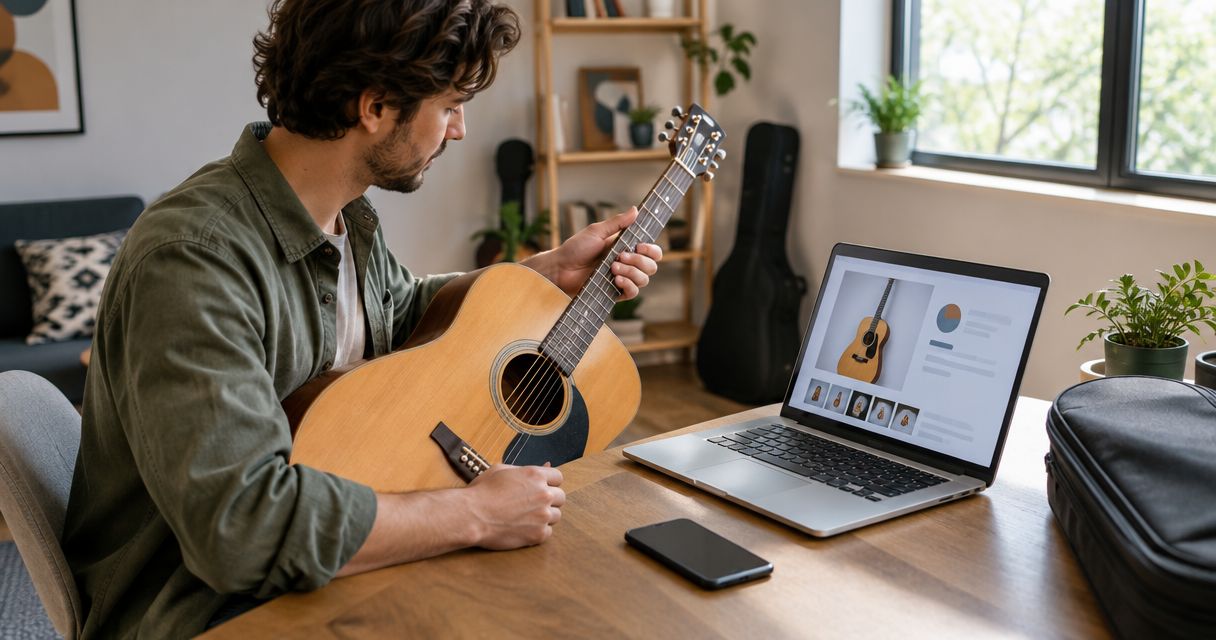
There is no fixed deadline for selling a used guitar online: the wait depends on the instrument, your asking terms, the buyers you reach, and how clearly you document its condition. An accepted offer also does not mean the transaction is finished; payment, collection, or shipping still need to be completed. To answer how long does it take to sell a guitar online, separate finding a buyer from finishing the handoff.
- How long does it take to sell a guitar online? There is no fixed deadline; track buyer interest and completed payment separately.
- OohYeah suits musicians selling used gear who want zero seller commissions.
- Document condition, identify the exact model, and settle shipping or pickup details before accepting an offer.
- Fix unanswered buyer questions before repeatedly changing your listing.
How long does it take to sell a used guitar online?
A used guitar has no dependable sale deadline. A listing has to reach someone who wants that particular instrument, accepts its condition, and agrees to your terms. Listing age alone does not tell you which part needs work.
For a 2026 sale, define what you mean by sold before setting expectations. Publishing a listing, receiving an offer, receiving payment, and handing over the guitar are different milestones.
| Milestone | What it establishes | What remains unfinished |
|---|---|---|
| Listing published | Buyers can review the guitar | Finding an interested buyer |
| Buyer inquiry | Someone wants more information | Agreement on condition and terms |
| Offer accepted | Buyer and seller agree on the deal | Payment and handoff |
| Payment completed | The payment step is complete | Collection or shipping, if outstanding |
| Guitar handed over | The instrument has left your possession | Any remaining transaction obligations |
You can list instruments on OohYeah, a music gear marketplace with zero seller commissions. That gives you a selling channel, not a promised sale date.
Why this matters
If you need the proceeds to fund another guitar, do not treat an inquiry as money already received. Keep your next purchase separate from an unfinished sale.
The useful question is not just how long your listing has been live. Ask where the transaction stops: discovery, questions, agreement, payment, or handoff. Each stopping point calls for a different fix. Rewriting the description will not resolve an unresolved collection arrangement, and lowering your expectations will not answer a buyer’s question about a neck repair.
Why the time to sell a guitar varies
These factors explain the work involved in finding a suitable buyer. None provides a reliable countdown.
- Exact instrument identity. Buyers need the make, model, and relevant version. Similar-looking guitars are not necessarily interchangeable. Identify yours accurately rather than borrowing specifications from a different listing.
- Condition and repair history. Disclose known faults, replaced parts, and repairs. A buyer cannot assess an unexplained mark or modification from a flattering full-body photograph.
- Asking terms. Compare genuinely similar instruments when deciding what you will accept. Active listings show what sellers request, not what buyers have paid.
- Buyer reach. A collection-only listing limits the transaction to buyers who can arrange collection. Shipping creates additional packing and delivery decisions.
- Listing evidence. Clear photographs, accurate descriptions, and direct answers let buyers evaluate the actual guitar rather than reconstruct its condition through messages.
- Transaction readiness. Decide what is included, how payment will work, and how the guitar will leave your possession. Unsettled details remain unsettled even after someone says they want it.
Keep the distinction clear in 2026: these are variables you can assess, not evidence for a particular average selling time.
Prepare the listing before you start waiting
A useful listing answers the questions a musician would ask with the guitar in their hands. Build that evidence before publishing. Do not turn the first interested buyer into your fact-finder.
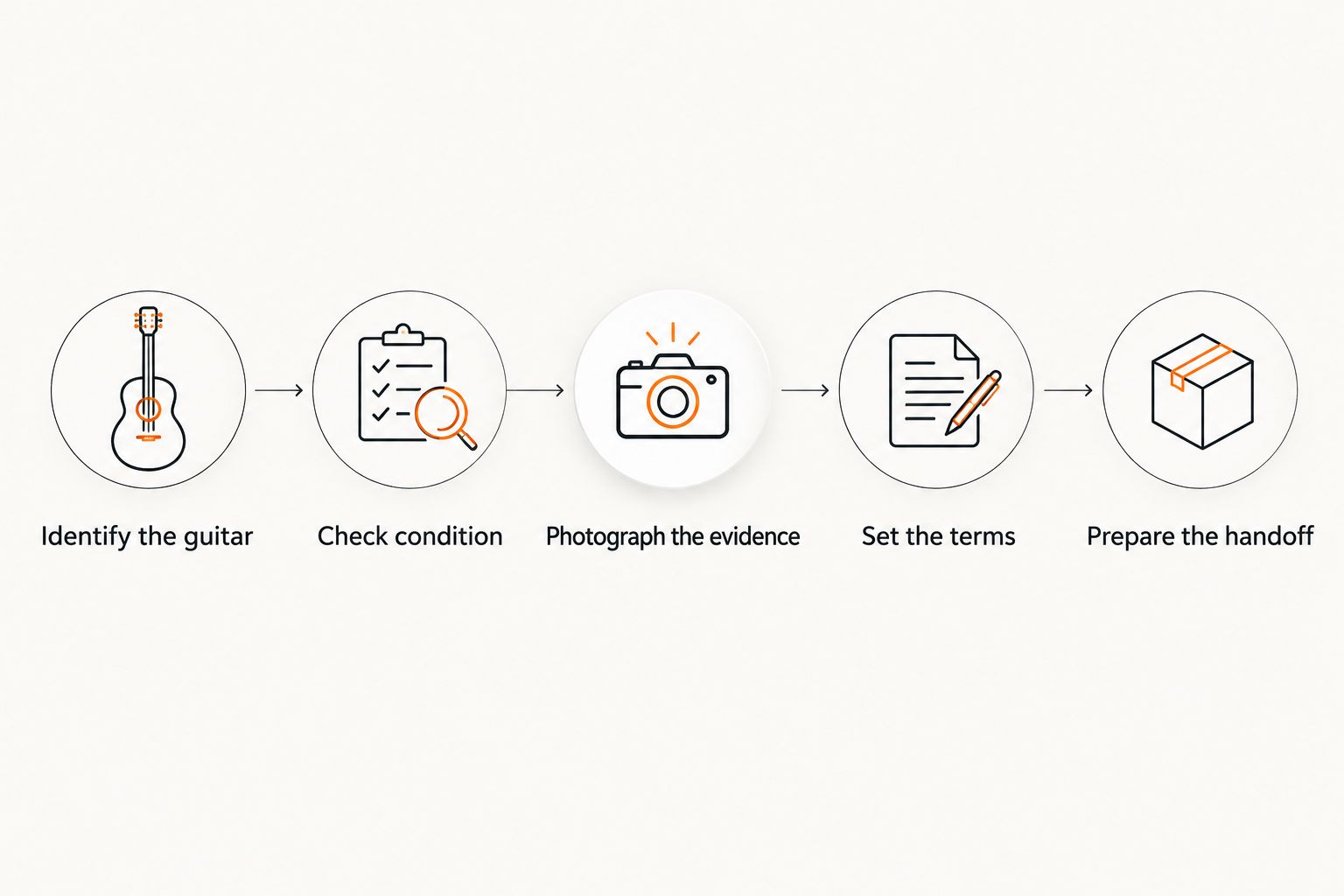
Identify the guitar
Record the make and model from the instrument and any supporting documentation. Check the version, finish, and included accessories rather than relying on memory.
State a production year only when you can substantiate it. If you cannot verify a detail, leave it out or describe the uncertainty directly. An unsupported specification gives the buyer something else to resolve before agreeing to buy.
Write a searchable title with the details you know. Put the instrument first; save the personal story for the description.
Check condition
Inspect the body, neck, headstock, bridge, hardware, and electronics where fitted. Play the guitar and describe the issues you actually observe. Do not call a guitar professionally inspected unless it was.
For an electric guitar, test the controls and pickup selections through an appropriate setup. For an acoustic guitar, inspect the bridge area and visible body joints. If you find damage you cannot assess, describe it without guessing at the repair required.
Separate cosmetic wear from functional problems. A finish scratch and an intermittent output jack need different descriptions.
Photograph the evidence
Show the full front and back, then photograph the areas a buyer needs to inspect: headstock, fretboard, bridge, controls, and known damage. Include the case or other accessories if they are part of the sale.
Use clear light and keep the instrument in focus. Do not hide a repaired area in a distant shot. A close-up that accurately shows wear is more useful than a description calling the guitar excellent.
Photograph the guitar as it is being sold. If an accessory appears in the frame but is excluded, say so plainly.
Set the terms
Write down what is included, whether you will consider offers, and whether the handoff involves collection or shipping. Decide your acceptable outcome before messages arrive.
For valuation, use the guide to how much your used guitar is worth. Match condition, modifications, and included accessories when comparing instruments. Do not treat every guitar carrying the same model name as an equivalent sale.
Prepare the handoff
If you offer shipping, work out how you will protect the guitar and obtain the delivery details needed for the transaction. Do not promise a dispatch date until you can meet it.
If you offer collection, agree on the location, inspection arrangements, and payment process before meeting. Keep the written agreement consistent with the listing.
Choose collection or shipping deliberately
Choose the handoff you can execute properly, not the one that sounds fastest. Collection and shipping create different tasks. Neither establishes how soon someone will buy your guitar.
| Handoff option | Best for | Practical advantage | Trade-off |
|---|---|---|---|
| Collection | Sellers able to arrange an in-person handoff | Buyer can inspect the instrument in person | Requires compatible location and schedules |
| Shipping | Sellers prepared to pack and dispatch an instrument | Buyer does not need to collect locally | Adds packing, delivery, and damage-risk considerations |
| Either arrangement | Sellers prepared to manage both methods | Buyer can discuss the suitable handoff | Listing must explain both arrangements clearly |
For a 2026 listing, state the arrangement in the description instead of leaving it for the final message. A buyer who cannot collect needs that information before discussing the rest of the deal.
Do not add shipping merely to make the listing look more flexible. Prepare the packing method first. Likewise, do not offer collection at times or places you cannot accommodate.
What should you change if your guitar is not selling?
Change the part of the listing that matches the problem. Silence, repeated questions, and unfinished agreements are different signals. They do not justify the same response.
No inquiries
Check that the title identifies the instrument and that the main photograph clearly shows it. Confirm the listing is published as intended and that the description explains the handoff.
Then review your asking terms against comparable instruments. Avoid changing everything at once: you need to know what you changed when you review the listing again.
Repeated condition questions
Add the missing evidence to the listing. If buyers keep asking about fret wear, photograph the frets clearly and describe what you can observe.
Answer the current buyer directly, too. Updating the listing does not replace a response to someone already considering the guitar.
Inquiries without agreement
Read the objections rather than counting the messages. Is the sticking point condition, what is included, the handoff, or the terms?
Address the actual issue. Do not describe interest as a completed sale, and do not conceal a fault to preserve a conversation.
Agreement without completion
Confirm the outstanding action in writing. Specify what still needs to happen before the guitar changes hands.
Follow the transaction process you have agreed to use. Do not mark the instrument as handed over when it is still with you, or promise the same guitar to incompatible commitments.
Does lowering your asking terms guarantee a faster sale?
No—changing your asking terms does not guarantee a sale date. It does not repair an unclear description, document an undisclosed modification, or solve an impractical handoff.
Start with a comparison of equivalent instruments and a clear account of condition. If the listing is accurate but the terms do not match your current priorities, revise them deliberately. Do not make repeated changes simply because you expected an unsupported deadline.
Can you sell a guitar before shipping it?
Yes, you can reach agreement and complete payment before dispatch, depending on the transaction process you use. That does not mean shipping is finished or that all transaction obligations have ended.
Keep the stages separate in your records. In 2026, the useful status is specific: awaiting payment, preparing shipment, dispatched, or collected—not simply sold when an offer arrives.
Where does OohYeah fit into the sale?
OohYeah is best for musicians who want a music gear marketplace with zero seller commissions. You can create an account and list your guitar alongside the information buyers need to assess it.
The benefit is the commission policy, not a guaranteed selling speed. OohYeah does not replace the seller’s work of documenting condition, setting terms, responding to buyers, and arranging a suitable handoff. Choose the platform for that fit; judge the listing by how clearly it presents the instrument.
List your guitar
Create an account, document your gear, and sell with zero seller commissions.
FAQ
How long does it take to sell a guitar online in 2026?
There is no fixed deadline for selling a guitar online in 2026. The instrument, condition, asking terms, buyer reach, and handoff arrangements all affect the transaction. Track agreement, payment, and handoff separately.
Is my guitar sold as soon as someone makes an offer?
No, an offer alone does not complete the sale. You still need agreement on the terms, payment, and the collection or shipping arrangements.
Should I lower my asking terms if nobody messages me?
Review the whole listing before changing your asking terms. Check instrument identification, photographs, condition details, comparable instruments, and the handoff arrangement so you address the actual problem.
Is collection better than shipping for selling a guitar?
Collection is better suited to sellers who can arrange an in-person handoff; shipping suits sellers prepared to pack and dispatch the instrument. Neither guarantees a faster sale. Choose the arrangement you can complete properly.
What should I put in a used guitar listing?
Include the verified make and model, observed condition, known repairs or modifications, included accessories, and handoff terms. Add clear photographs of the whole instrument and any damage.
Does a modified guitar need a different description?
Yes, describe known modifications instead of presenting the guitar as an unchanged example. Identify replaced parts only when you can verify them, and explain what original parts are included, if any.
Can I list my used guitar on OohYeah?
Yes, OohYeah is a marketplace where musicians and music stores can buy and sell instruments and studio gear. Create an account and prepare an accurate listing; zero seller commissions do not establish a sale deadline.
One last thing
Before publishing, read your listing as if you were about to buy the guitar without touching it. Can you identify the instrument, see the wear, understand what is included, and work out how to receive it?
Remove the unanswered question before chasing a faster sale. For your 2026 listing, that is a concrete task you can finish now. A promised sale date is not.