Verify a music gear seller by checking the account history, requesting fresh proof that they possess the exact item, testing its condition, and reviewing payment protections before sending money. In 2026, a convincing profile or polished demo still does not prove ownership, working condition, or eligibility for a refund. Treat verification as a chain of evidence—not a badge.
- How to verify a seller on music gear marketplace: match account history, fresh ownership evidence, gear tests, and payment terms.
- OohYeah connects gear buyers and sellers; verify the individual seller and transaction before paying.
- A serial number helps identify equipment but does not prove ownership or working condition.
- Stop when the seller's identity, item details, or payment instructions conflict.
Why this matters
You are checking separate things: whether the person controls the account, whether they possess the gear, and whether the instrument or studio equipment matches the listing. Evidence for one does not establish the others. A real musician can sell a faulty interface; a functioning guitar can still come with an unclear ownership story.
OohYeah is a music gear marketplace for buying and selling instruments and studio equipment. Wherever you shop in 2026, keep your purchase decision tied to evidence about the specific seller and item—not the marketplace name alone.
How do I verify a seller on a music gear marketplace?
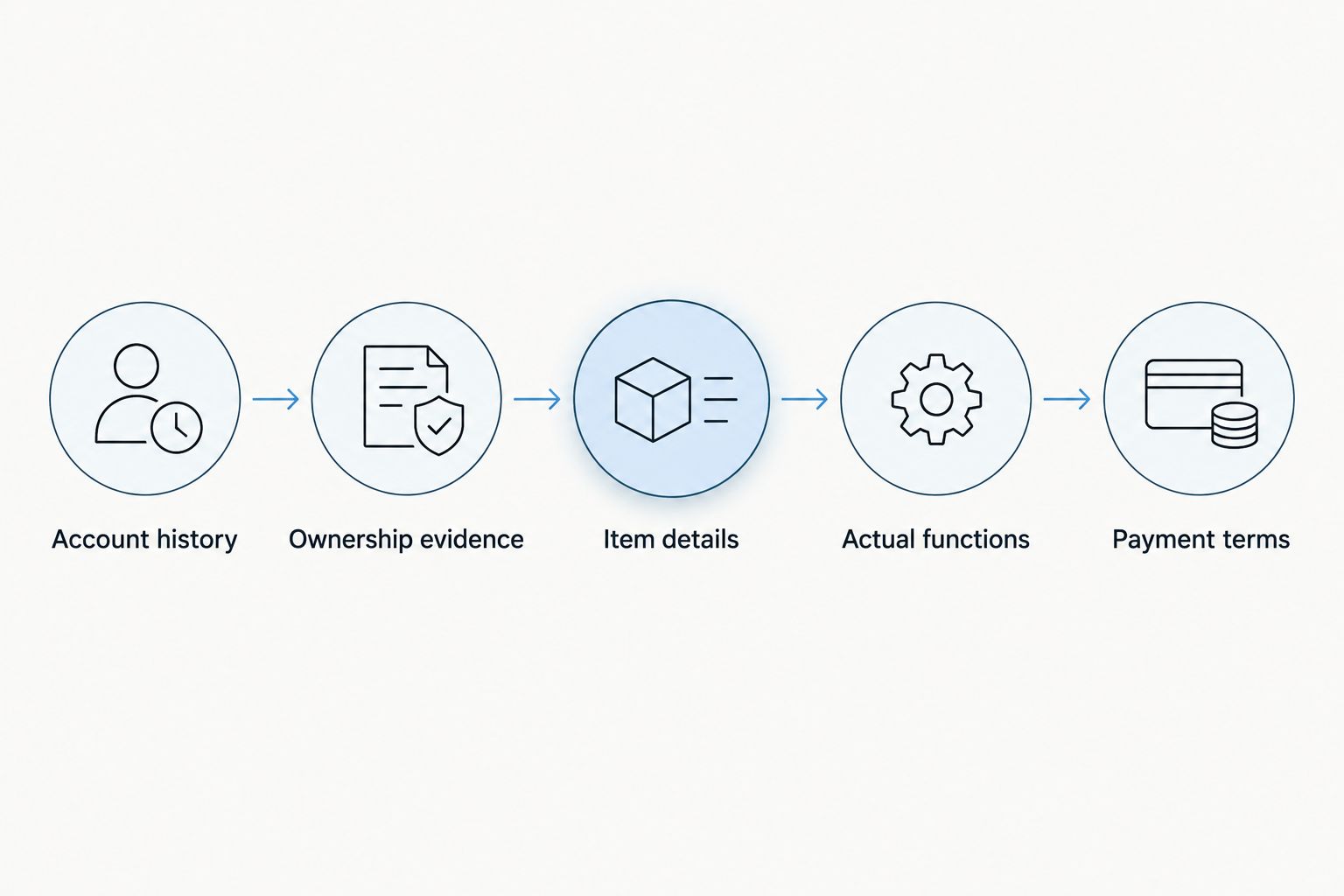
Use these 5 checks in order. Save the listing and messages as you go, and resolve contradictions before discussing payment.
1. Check account history
Read the profile and any available transaction feedback. Look for comments about accurate descriptions, communication, packing, and problem resolution—not just praise that says nothing about a purchase.
Check whether the seller's name, location, and description stay consistent across the listing and conversation. If the seller claims to represent a music store, independently find that business and ask it to confirm the listing through an established contact channel.
A new account needs stronger item-specific evidence. An older account still needs checking: history tells you about past activity, not necessarily who controls the account today.
2. Request ownership evidence
Ask for a fresh photo showing the actual item beside a handwritten phrase you choose. Request an angle missing from the listing, such as the rear connections, headstock back, underside, or accessory compartment.
A useful request is specific: show the rear panel, the serial label, and a handwritten note in the same frame. Avoid asking for a passport or driver's license; collecting sensitive documents creates privacy risks without proving the gear belongs to the sender.
Run a reverse image search on the listing photos. If the same photos appear elsewhere, ask why. Cross-listing is not automatically dishonest, but conflicting locations, descriptions, or seller identities need an explanation you can check.
3. Match item details
Compare the model name, finish, controls, connectors, visible wear, and identifying marks across every photo. Read the listing against those details rather than assuming the title is accurate.
Ask about repairs, replaced parts, modifications, intermittent faults, and included accessories. For a guitar, that means more than cosmetic condition; for studio gear, distinguish the hardware from any software or licenses pictured alongside it.
A receipt or service document can support the seller's account. It does not replace fresh evidence, and personal information unrelated to the purchase can remain covered.
4. Test actual functions
Request an uninterrupted demonstration that shows the item, its identifying details, and the functions you need. Ask the seller to explain the signal path: what is connected, what you are hearing, and whether external processing is involved.
For a guitar, request each pickup setting and control, plus playing across the neck. For an audio interface, ask for a demonstration of the inputs and outputs you intend to use. For a keyboard, ask about keys, pedals, controls, and relevant connections.
A video establishes only what it shows. A clean recording does not establish every input works, and a power light does not establish that a unit passes audio correctly.
5. Review payment terms
Before paying in 2026, open the marketplace and payment provider through your own trusted route. Read the current rules for the transaction type, including eligibility, exclusions, evidence requirements, and dispute deadlines.
Keep the agreed condition, accessories, delivery method, and seller promises in writing. Do not assume a payment is covered just because a familiar provider processes it.
If a seller changes the recipient, payment route, or transaction terms at the last moment, pause. Reconcile the change independently before proceeding.
These checks work together. Account history provides context, fresh evidence connects the seller to the item, and testing addresses condition; none replaces the payment review.
Which verification methods are most useful?
Use at least 2 different evidence types: possession evidence and functional evidence. A fresh photo addresses whether the seller can access the item; a targeted demonstration addresses whether the relevant functions work.
| Verification method | Best for | What it supports | Limitation |
|---|---|---|---|
| Transaction feedback | Reviewing seller history | Previous buyers' reported experiences | Does not verify the current item or account operator |
| Fresh requested photo | Checking current possession | Access to the specific gear shown | Does not establish ownership rights or condition |
| Live video demonstration | Asking follow-up questions | Possession and the functions demonstrated | Does not replace hands-on inspection |
| Serial and document checks | Matching item identity | Consistency between gear and supporting records | A matching number is not an ownership guarantee |
| In-person inspection | Testing the actual item | Observable condition before handover | Hidden or intermittent faults can remain |
Do not turn this table into a points system. Several weak signals do not cancel a serious contradiction, such as a serial label that changes between photos.
Choose the method that answers the unresolved question. If you already have clear photos but cannot confirm the output works, another exterior photo adds little; ask for an audio test.
What should I ask before buying used music gear?
Send 1 clear message covering the item and the transaction. Keep it practical rather than accusatory:
- Confirm the exact model and everything included.
- Describe any faults, repairs, modifications, or replaced parts.
- Send a fresh photo with the handwritten phrase requested.
- Demonstrate the functions relevant to your setup.
- Confirm the proposed delivery and payment arrangements in writing.
Then follow up on anything vague. “Works great” is not an answer to whether a headphone socket cuts out or a keyboard key triggers inconsistently.
For studio equipment, ask whether required software is still supported and whether any included license can legally transfer. Check the manufacturer's current compatibility information yourself; the seller's working setup does not establish compatibility with your computer.
For acoustic instruments, ask specifically about structural repairs and current playability. If you cannot assess the answer, arrange an inspection by a qualified repair professional rather than guessing from photos.
What are the warning signs that mean I should stop?
Stop when the seller asks you to accept unresolved contradictions. Refusing one particular request is not proof of fraud, but refusing every reasonable alternative leaves you without enough evidence to proceed.
Watch for these patterns:
- Changing identity: names, business affiliations, or payment recipients change without a checkable explanation.
- Recycled evidence: every request produces existing listing photos rather than the requested detail.
- Conflicting gear: serial labels, wear marks, controls, or accessories differ between images.
- Payment pressure: urgency replaces answers about condition, ownership, or transaction terms.
- Unexpected links: a message sends you to a login or payment page you did not independently open.
- Verification-code requests: the seller asks for a code sent to your phone or account.
Do not share login credentials or verification codes. If you suspect account misuse, stop communicating through any questionable external channel and use the marketplace's official reporting route where available.
You do not need to prove fraud to decline a purchase. Unresolved risk is enough reason to walk away.
Why seller verification varies by transaction
The core checks stay the same, but the evidence you need depends on what you are buying and how you will receive it.
- Account history: a seller without transaction feedback needs other ways to establish credibility.
- Gear complexity: an instrument's acoustic response and an interface's computer compatibility require different tests.
- Modifications: replaced pickups, altered wiring, or repaired electronics need specific disclosure and inspection.
- Delivery method: local collection allows hands-on checks; shipping requires clear written condition and packing arrangements.
- Ownership context: a private sale, store listing, or sale on someone else's behalf needs a consistent explanation of who can authorize it.
- Payment rules: protection depends on the provider's current terms and the transaction's eligibility.
These factors explain why a generic “verified seller” label cannot answer every buying question. Read what a label actually verifies before treating it as evidence of anything else.
Can I verify a seller without meeting in person?
You can check a remote seller through fresh requested photos, a live demonstration, consistent records, and written transaction terms. Remote checks do not replace every part of a hands-on inspection.
During a live call, ask for an action you choose at that moment: switch a pickup, demonstrate a control, or show a particular connection. Keep the request relevant to the item rather than asking the seller to perform unrelated identity checks.
For shipped purchases, agree on packing and delivery details before payment. Record what is included and how the seller describes the condition, then inspect the package and equipment when they arrive.
Does a serial number prove a seller is legitimate?
A serial number helps identify an item; it does not prove the seller owns it or that it works. Compare the number on the actual gear with the listing and any supporting documents.
Where the manufacturer offers a lookup or support channel, use it to check what the number establishes. Do not assume every manufacturer maintains a public registry or that a valid number rules out counterfeit parts, modifications, or theft.
Avoid publishing someone else's personal records while researching an item. You need relevant evidence, not a public dossier on the seller.
Where OohYeah fits your gear search
OohYeah fits musicians who want a music gear marketplace alongside music professional services. You can buy and sell instruments and studio equipment, while also finding professionals such as producers and engineers.
That scope helps if your music work involves both gear and hired talent. It does not replace seller-specific checks: establish possession, condition, and transaction terms before committing to an individual purchase.
Buy the gear you can verify. Leave the unexplained listing alone.
FAQ
What's the first thing I should check about a music gear seller?
Check whether the account history, listing details, and seller's messages are consistent. Then request fresh evidence connecting that seller to the exact item.
Is an established seller account enough to trust a listing?
An established account is not enough to verify a listing. Check the current item, request a relevant demonstration, and review the proposed transaction separately.
What photo should I ask a seller to send?
Ask for a fresh photo of the actual gear beside a handwritten phrase you choose. Include a specific angle or identifying detail missing from the listing.
Is a live video call better than a recorded demo?
A live video call lets you request relevant actions and ask follow-up questions in real time. It still establishes only the condition and functions demonstrated, not every possible fault.
Should I send a deposit before verifying the gear?
Do not send a deposit before resolving ownership, condition, and payment questions. Check the terms governing that payment rather than assuming it is refundable or protected.
Can I ask a seller for their driver's license?
Avoid requesting sensitive identity documents for a routine gear purchase. Fresh item-specific evidence and independently confirmed business details are more relevant to verifying the transaction.
Does buying through OohYeah replace seller verification?
Buying through OohYeah does not replace checking the individual seller and item. Confirm possession, condition, included accessories, and the applicable transaction terms before paying.
What should I do if the seller changes payment details?
Pause the purchase when payment details change unexpectedly. Confirm the reason through an independently trusted channel and review whether the revised transaction remains eligible for any applicable protection.
One last thing
Make the proof request about a function, not just a face. A friendly video introduction tells you less about an interface than a clear demonstration of the input you need for recording vocals.
For your next purchase in 2026, write down the single unanswered question that would stop you buying. Ask for evidence that answers it before sending money. If the seller cannot provide it, keep looking.