The cost to hire a music producer in 2026 depends on the work you commission and the terms you agree to, not a universal rate. Get a project-specific quote that separates production from recording, editing, mixing, mastering, and outside musicians. Before you book, confirm what the fee covers, what triggers additional charges, and whether the producer also receives royalties or ownership rights.
- The cost to hire a music producer depends on scope, deliverables, revisions, and rights—not just the billing method.
- Compare music production quotes for the same work; studio recording, mixing, and mastering are separate unless included.
- OohYeah connects musicians with music professionals; choose a producer whose work fits your project.
- Agree on production fees and royalty terms separately before recording begins.
Why this matters
A production quote means little until you know what the producer is delivering. Building an arrangement around your vocal is different from directing a band session or finishing an existing beat. The same label—music production—can describe different jobs.
You can find music professionals through OohYeah, but the marketplace is only the starting point. Your brief, the producer's proposal, and your agreement determine the job. Compare the work before you compare the quote. For your 2026 release, put the creative target and the finished deliverables in writing before committing.
How much does it cost to hire a music producer in 2026?
Your cost is the agreed production fee plus any separately contracted work, expenses, and rights-related payments. An hourly quote needs an estimate of the time involved. A project quote needs a clear definition of the finished project. Neither tells you the total commitment on its own.
Start with the billing structure. These are ways to organize an agreement, not standardized packages or guaranteed levels of service.
| Billing structure | Best for | What to clarify | Main advantage | Main limitation |
|---|---|---|---|---|
| Hourly | Defined sessions or targeted production help | Estimated hours, preparation, editing, and approval for extra time | You can commission specific work | The total depends on time used |
| Per song | A track with a settled brief | Arrangement, recording, revisions, and delivery files | You can compare a defined song-level scope | Changes outside the brief need separate agreement |
| Project fee | An EP, album, or connected set of tracks | Song scope, milestones, shared sessions, and exclusions | You can plan the complete production assignment | An unclear scope makes changes difficult to resolve |
| Fee plus royalties | A collaboration with negotiated ongoing participation | Upfront work, royalty basis, accounting, and rights | Compensation can reflect an ongoing creative relationship | Your obligations continue beyond delivery |
For a useful 2026 comparison, send each producer the same demo, brief, and delivery requirements. Ask for an itemized proposal rather than a headline figure with unspecified inclusions.
Build your budget around the complete job
Separate the producer's creative work from the resources needed to finish it. Ask who supplies the recording space, who engineers sessions, and who handles editing. Then confirm whether mixing and mastering belong to the same agreement or require separate bookings.
Don't count the same service twice. If the production proposal includes vocal editing, remove that task from any separate engineering brief. If the proposal excludes mastering, keep mastering visible in your release plan. A clear budget assigns every task to someone and leaves no task hidden inside a vague promise.
Hourly production: define the session and stopping point
Hourly production suits work you can describe precisely: arranging a chorus, directing a recording session, or reviewing and revising an existing production. Give the producer the material in advance. Ask whether preparation and work after the session count as billable time.
Best for: artists who need focused help rather than an undefined end-to-end assignment. Its advantage is flexibility; its limitation is that the total changes with the time spent. Agree on an estimated workload and an approval point before additional work begins.
Keep sessions decision-focused. Know which song you're working on, which files you're bringing, and what you want to resolve. Open-ended experimentation is a valid creative choice, but it needs its own scope—not an assumption that every idea fits inside the original session.
Per-song production: define what finished means
A per-song agreement works when you know the song and the production target. Specify whether the producer starts with a voice memo, a written arrangement, recorded stems, or an existing session. Those starting points require different work.
Best for: artists commissioning a track with a clear creative direction. The advantage is a defined assignment; the limitation is that substantial changes can fall outside it. Replacing the arrangement after approving it is not the same as adjusting a vocal level.
Name the delivery files. A finished stereo mix, instrumental version, grouped stems, and editable session are different deliverables. Ask which are included and whether you need anything else for live performance, remixes, or later engineering work. Don't assume that paying for production automatically includes every working file.
Project production: define the songs and shared direction
An EP or album agreement needs both song-level detail and a project-wide plan. Identify which tracks need full production, which need lighter work, and which are already complete. State whether the producer is also responsible for consistency across the project.
Best for: artists commissioning connected material with an agreed creative direction. The advantage is that you can plan the work together; the limitation is that an undefined track list or changing brief makes the assignment harder to control.
Set approval milestones around actual decisions: arrangement, recorded performances, production edits, and final delivery. Keep the schedule tied to what both sides must provide. A producer cannot complete vocal production while waiting for your replacement takes, and you cannot approve a mix you have not received.
Why the cost to hire a music producer varies
Different quotes can reflect different jobs. Check these factors before treating the difference as a disagreement about value:
- Starting material: A rough demo requires different development from organized recordings with approved arrangements.
- Creative scope: Song development, beat creation, arrangement, and performance direction are distinct responsibilities.
- Recording resources: Studio space, engineering, equipment needs, and outside performers require explicit arrangements.
- Finishing work: Editing, mixing, mastering, and alternate versions are included only when the agreement says so.
- Revision scope: Small adjustments and a new creative direction are different kinds of work.
- Rights and compensation: Production fees, songwriting shares, master rights, and royalties need separate discussion.
Ask each producer to explain the work behind the proposal. You are choosing a collaborator, not just a billing structure. Listen for relevant production decisions: vocal treatment, arrangement choices, drum sound, and how the production supports the song.
Get a quote you can actually compare
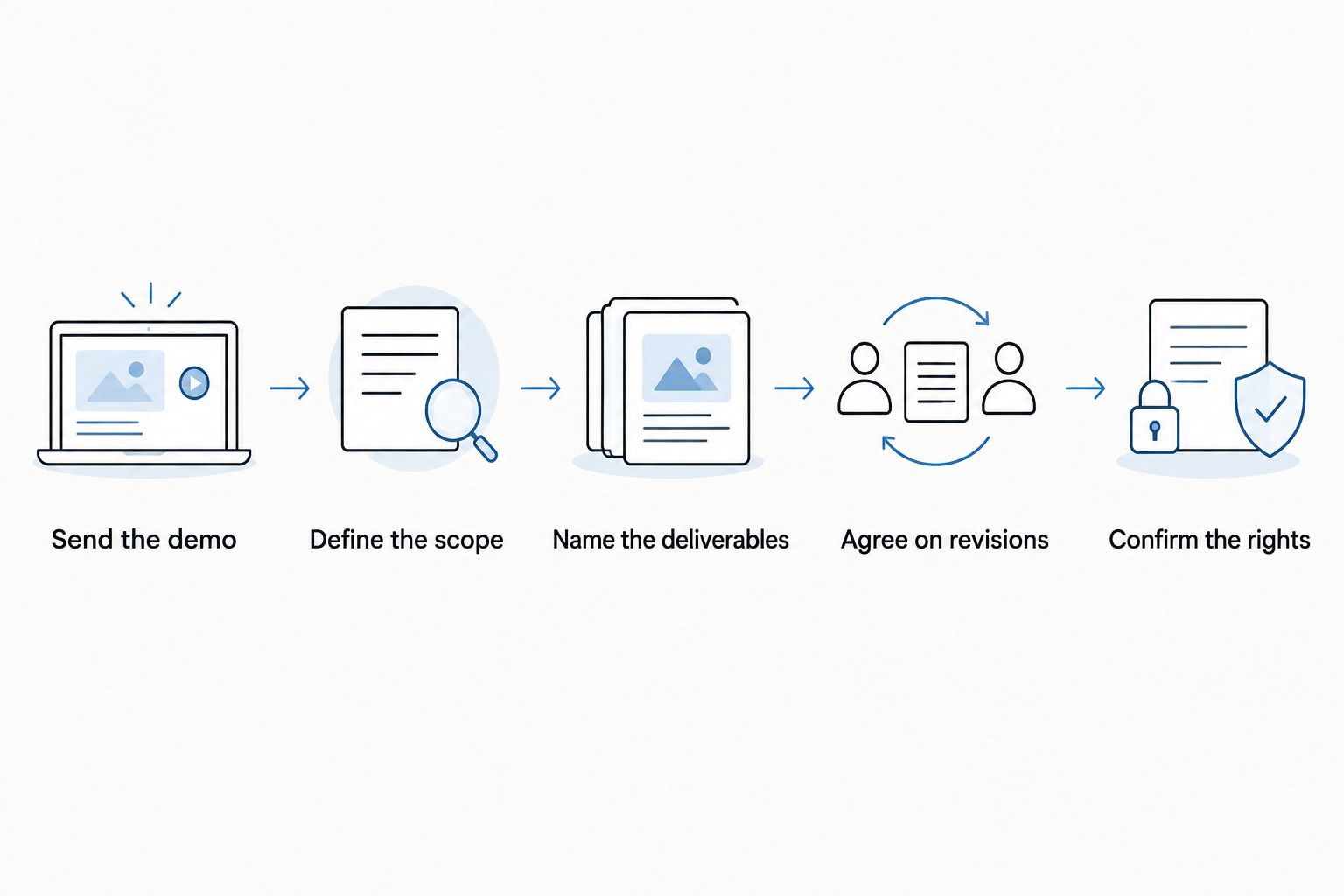
Build your 2026 production brief before requesting proposals. It does not need fancy formatting. It needs decisions the producer can act on.
- Send the demo. Include the current song, lyrics where relevant, and recordings the producer will work from. Explain what is final and what is still open.
- Define the scope. State whether you need arrangement, recording direction, programming, editing, mixing, or a complete production assignment. Identify work handled elsewhere.
- Name the deliverables. List the files you need and the intended use. Separate release files from stems, alternate versions, and editable sessions.
- Agree on revisions. Ask how feedback rounds work, what counts as a revision, and how a changed brief is handled. Put those boundaries in the agreement.
- Confirm the rights. Resolve credit, royalty participation, songwriting contributions, master ownership, and permissions before work starts.
The sequence matters: scope first, then deliverables, then terms. A quote cannot answer an undefined brief. Keep the written agreement aligned with the proposal you accepted.
For the booking process, follow the guide to hiring a music producer from first message to final mix. Keep approvals in writing, and send consolidated feedback rather than scattered messages that contradict each other.
OohYeah is best for musicians seeking producers in a music-focused marketplace. Its relevant advantage is access to music professionals; choosing the right collaborator still requires listening to their work and agreeing on scope. The platform does not replace that conversation.
Find your production collaborator
Explore OohYeah, then discuss your demo, production scope, deliverables, and rights with a music professional.
Separate production, engineering, mixing, and mastering
A producer shapes the musical recording: its direction, arrangement, performances, and production choices. A recording engineer handles recording tasks. A mixing engineer balances and processes the recorded elements. A mastering engineer prepares the finished mix for its intended release requirements.
People can perform several of these roles. That does not mean a production quote includes all of them. Ask who does each job and who is accountable for delivery.
For a 2026 project, request a written inclusion list rather than relying on a phrase such as complete production. If the producer also mixes, confirm whether mixing feedback is part of the production revisions or a separate stage. If someone else masters the track, establish who supplies the approved mix and communicates the delivery requirements.
Treat royalties and ownership as separate decisions
An upfront production fee and ongoing royalty participation are different commitments. Ask what any royalty is calculated from, who accounts for it, and how payment works. A verbal promise about future earnings is not a usable accounting agreement.
Songwriting rights and rights in the recording are also different. Discuss actual contributions and proposed terms rather than assuming the producer's title determines ownership. Credit does not, by itself, explain compensation or permission to use the work.
Agree on rights before the recording becomes a release. If the arrangement includes publishing, master ownership, samples, or ongoing royalties, get qualified legal advice on the agreement. Resolve those questions while both sides can still choose whether to proceed.
Does a producer's fee include mixing and mastering?
A producer's fee includes mixing and mastering only when those services appear in the agreed scope. Ask for separate confirmation of each stage and its deliverables.
If the producer hands off to another engineer, identify who manages that handoff. You need an approved production, usable files, and a clear next step—not uncertainty about who finishes the track.
Can I hire a producer for just part of a song?
You can commission a defined production task when the producer agrees to that scope. Describe the task directly: improve an arrangement, program drums, direct vocals, or develop a section.
Targeted help is useful when you want to retain responsibility for the rest of the recording. State which creative decisions remain yours and which files the producer must return.
Should I choose the lowest quote?
Choose the quote that covers the work you need and comes from a producer whose relevant recordings you trust. A smaller scope is not the same purchase as a complete production assignment.
Listen beyond the artist's name. Check whether you like the arrangements, performances, and sonic choices the producer actually contributed to. Then compare inclusions, revision terms, deliverables, and rights.
FAQ
How do I work out the cost to hire a music producer?
Get a written quote for a defined production scope. Separate the producer's work from studio sessions, engineering, outside musicians, mixing, mastering, and any ongoing royalty obligations.
Is an hourly producer better than a per-song producer?
Hourly billing fits defined sessions, while per-song billing fits a track with an agreed scope. Neither structure guarantees better production; compare the work, deliverables, and terms.
Does hiring a producer give me ownership of the recording?
Hiring a producer does not settle ownership by itself. Your agreement needs to address rights in the recording, songwriting contributions, permissions, and any ongoing compensation.
What should I send a music producer before asking for a quote?
Send your demo, creative brief, starting files, and required deliverables. Explain which parts are final, which need development, and who handles recording, mixing, and mastering.
Are revisions included when I hire a music producer?
Revisions are included only to the extent your agreement provides for them. Confirm how feedback rounds work and whether a new arrangement or changed direction requires a separate agreement.
Can I find music producers on OohYeah?
OohYeah is a marketplace where musicians can hire music professionals, including producers. Evaluate relevant work and agree on scope, deliverables, revisions, and rights before booking.
Do I need a separate mixing engineer?
You need a separate mixing arrangement if mixing is not included in the producer's scope. The producer can also handle mixing when both sides explicitly agree to that responsibility.
One last thing
Before accepting a 2026 production proposal, ask the producer to describe the handoff: what files arrive, what work is complete, and what still needs doing. That answer exposes gaps a headline fee cannot show. Book a defined result, not an undefined promise. Your next move is simple: finish the brief, request the proposal, and settle the terms before the session.