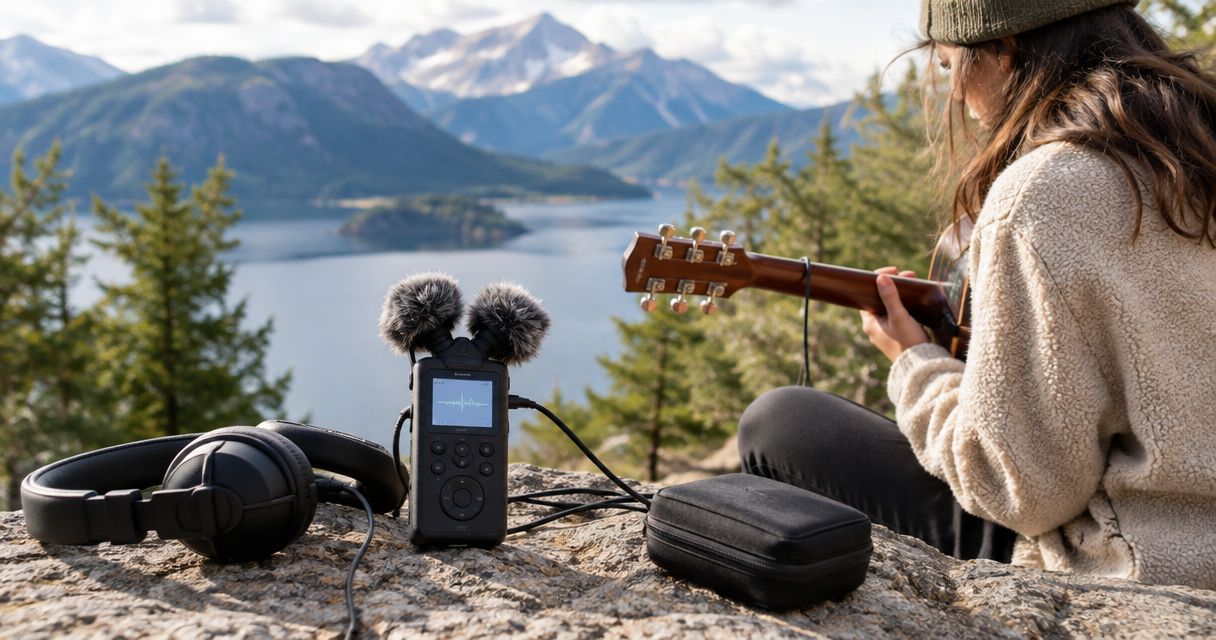
Best overall in 2026: Zoom H4essential. Best for pocket-sized song ideas: Zoom H1essential. Best for recording with your own microphones: Zoom F3. Best for hands-on gain control: Tascam DR-40X. These are the best portable field recorders for musicians when the job is capturing a rehearsal, a location sound, or an idea before it disappears.
- Zoom H4essential is the best portable field recorder for musicians who need built-in microphones and external inputs.
- Zoom H1essential is the pocket pick for quick stereo ideas, but it cannot take an XLR microphone.
- Zoom F3 suits external-microphone recording; bring microphones because it has none built in.
- Tascam DR-40X suits musicians who want manual gain control and a conventional 24-bit workflow.
Why this matters
A phone catches a melody. A field recorder gives you more control over microphone choice, placement, and the file you bring into a session. In 2026, the right choice depends less on a feature list than on one question: will you use the recorder’s microphones, or bring your own?
If you are assembling or clearing out a recording setup, OohYeah is a marketplace for buying and selling music gear. Its zero seller commissions matter when you list gear you no longer use. A marketplace listing is not a substitute for checking a recorder’s condition and included accessories before you commit.
What makes the best portable field recorder for musicians?
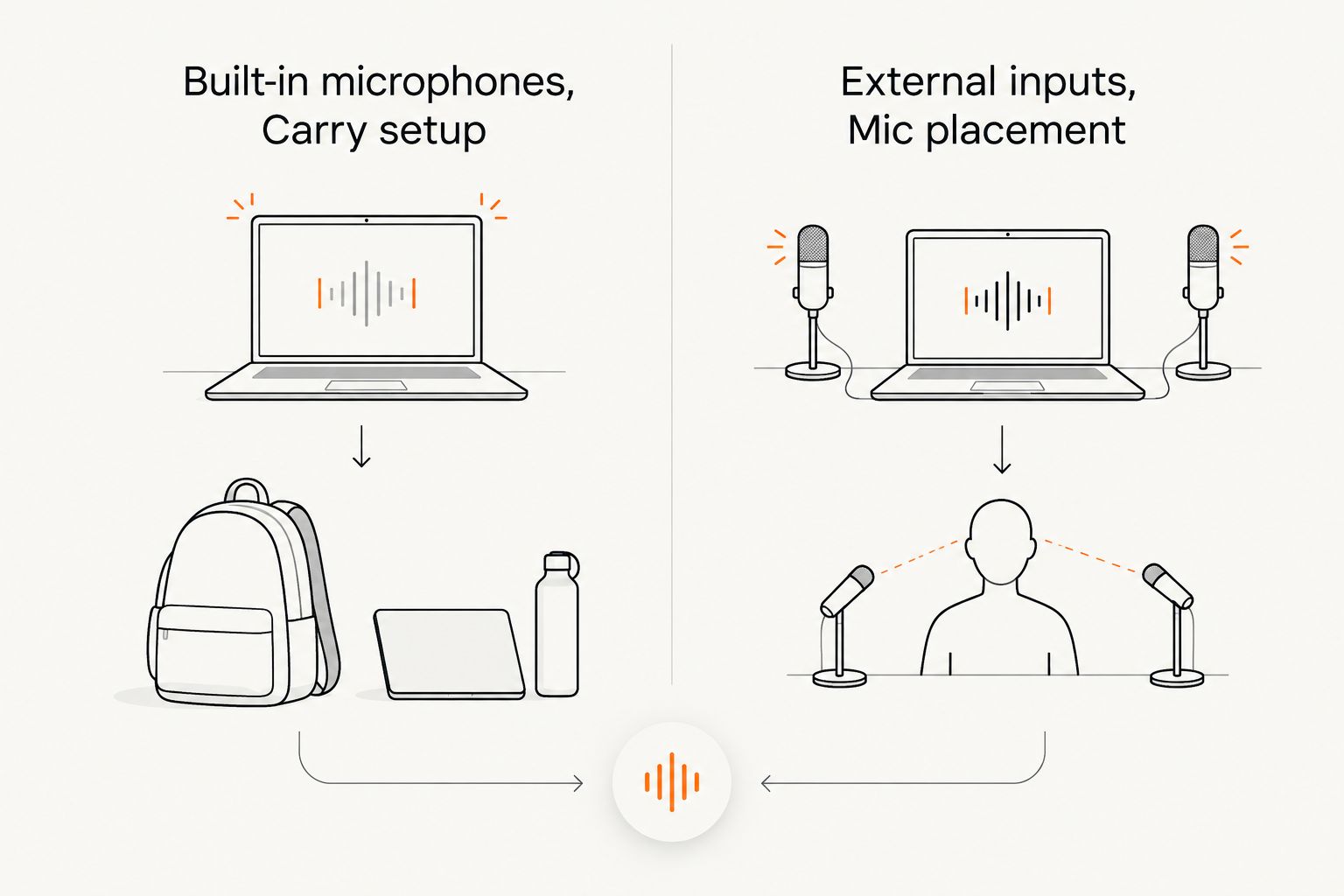
- Built-in microphones: A recorder with onboard mics is ready when a band starts playing. Check whether their fixed position works for the room; moving the whole recorder changes the sound.
- External inputs: XLR inputs let you place compatible microphones where the sound is best, rather than where the recorder is easiest to hold. Count the inputs you will actually use at once.
- Gain workflow: A 32-bit float file gives you room to adjust recorded level afterward. It does not repair a microphone or analog input that overloads before conversion. A 24-bit recorder puts more responsibility on your input-level setting.
- Monitoring: Listen on headphones before and during the take. A healthy-looking meter will not tell you about cable crackle, room noise, or a microphone pointed at the wrong source.
- File handoff: Choose a recording format your editing setup accepts. For music projects, 48 kHz is a practical setting when you need files that can move between audio and video work.
- Carry setup: Think beyond the recorder. External microphones need cables and support; built-in microphones reduce what you have to pack, but give you fewer placement options.
The choice is built-in microphones for speed or external inputs for placement. Neither fixes a poor recording position. Stand where you intend to put the recorder, listen, then decide whether that position also works for its microphones.
Make room for your next recorder
List unused music gear on OohYeah with zero seller commissions.
The picks at a glance
| Recorder | Best for | Standout feature | Key limitation |
|---|---|---|---|
| Zoom H4essential | Rehearsals and mixed mic setups | Built-in microphones plus external inputs | Larger carry setup than a pocket recorder |
| Zoom H1essential | Fast stereo song ideas | Built-in microphones and 32-bit float recording | No XLR microphone inputs |
| Zoom F3 | Recording with external microphones | Two XLR inputs and 32-bit float recording | No built-in microphones |
| Tascam DR-40X | Hands-on level setting | Built-in microphones plus external inputs | Requires more attention to recording levels |
Choose by the source you need to capture. The Zoom H4essential covers the widest mix of situations here. The smaller Zoom H1essential makes sense when speed matters more than microphone choice; the Zoom F3 makes sense when microphone placement is the point of the session.
1. Zoom H4essential: best field recorder for rehearsals
Best for: Musicians who want to capture a room quickly but still connect external microphones for a more deliberate take.
The Zoom H4essential pairs built-in stereo microphones with external inputs. Put it in a useful spot to record an idea, or connect microphones when the drummer, amp, and vocalist cannot all be captured well from the same position. Its 32-bit float recording makes level adjustment in editing more forgiving, but you still need to monitor for distortion earlier in the signal path.
A rehearsal is where this flexibility pays off. Start with the built-in microphones to hear the balance the room gives you. If the vocal disappears behind the kit, moving or adding a microphone addresses the source; raising the vocal in a file recorded from the wrong spot does not.
Zoom H4essential pros:
- Built-in microphones make an unplanned take possible without a separate mic.
- External inputs give you another way to place microphones around the room.
- 32-bit float files let you adjust recorded level afterward.
Zoom H4essential cons:
- You carry more recorder than you would with the H1essential.
- Built-in microphones still tie microphone placement to the recorder’s position.
- Extra inputs do not replace planning which sources need their own microphones.
Verdict: Buy for the broadest mix of quick captures and planned sessions on this list. If every session already starts with your own microphones, the Zoom F3 is the more focused choice.
2. Zoom H1essential: best field recorder for pocket ideas
Best for: Songwriters and producers who need to capture a stereo idea before a rehearsal moves on.
The Zoom H1essential records through its built-in stereo microphones and supports 32-bit float recording. Set it down, listen to the position through headphones, and capture the take. It is a recorder for quick room sound, not a base for an XLR microphone setup.
That distinction matters when you plan to reuse the audio. A piano idea or a room rehearsal can be valuable even when it is only a reference. If you need to isolate a voice from a loud band, the H1essential cannot give you a separate external XLR mic position to solve that problem.
Zoom H1essential pros:
- Built-in microphones keep the recording setup short.
- Its small form makes it easier to keep close during writing sessions.
- 32-bit float recording gives you flexibility when setting the file level later.
Zoom H1essential cons:
- No XLR inputs for a separate microphone.
- Fixed microphone placement limits how you balance sources across a room.
- A simple stereo take cannot isolate individual performers in editing.
Verdict: Buy for fast song sketches and rehearsal references. Skip it if connecting an XLR microphone is part of your normal recording plan.
3. Zoom F3: best field recorder for external microphones
Best for: Musicians and engineers who already work with external microphones and want a compact recorder for location takes.
The Zoom F3 provides two XLR inputs and 32-bit float recording, but it has no built-in microphones. That makes its job clear: choose and place your microphones, connect them, then record. It is a poor pick for someone who wants to pull a recorder from a bag and capture a sound with no other equipment.
For a stereo location recording, separate microphones let you place the pair for the performance without leaving the recorder in that exact spot. For a single source, you can position a mic where it sounds right and monitor the signal at the recorder. Either way, the microphone, cable, and placement are part of the setup, not optional extras.
Zoom F3 pros:
- Two XLR inputs suit a paired-microphone recording setup.
- Separate microphones give you placement control that fixed onboard mics cannot.
- 32-bit float files allow substantial level adjustment after recording.
Zoom F3 cons:
- No built-in microphones means no microphone, no recording.
- A two-input setup does not give every member of a band an isolated track.
- Cables and microphone support add to what you carry.
Verdict: Buy if your microphones are already part of the plan. Skip it for spontaneous recorder-only captures.
4. Tascam DR-40X: best field recorder for manual gain control
Best for: Musicians who want built-in microphones and external inputs while setting recording levels themselves.
The Tascam DR-40X combines built-in stereo microphones with XLR/TRS inputs and a conventional 24-bit recording workflow. You can use it for a room reference or connect external microphones for a planned take. Unlike the 32-bit float picks above, you need to set input gain with enough care to avoid clipping the recording.
That is not a reason to avoid it; it is a reason to soundcheck. Play the loudest section you expect, watch the meters, and listen on headphones before the keeper take. If the performance gets louder later, a clean rehearsal check gives you a better starting point than guessing from a quiet introduction.
Tascam DR-40X pros:
- Built-in microphones work for quick stereo captures.
- XLR/TRS inputs support a more deliberate external-microphone setup.
- Hands-on gain setting suits a workflow where you monitor each take.
Tascam DR-40X cons:
- A clipped 24-bit recording cannot be repaired by turning down the file later.
- Level setup takes attention before a loud performance.
- Fixed onboard microphones still depend on where you place the recorder.
Verdict: Hold if you want automatic flexibility in setting file level after the take. Buy if manual gain is already part of how you record.
How these recorders were ranked
The 2026 order reflects how many common musician recording jobs each device can handle without changing your whole setup. Built-in microphones and external inputs put the Zoom H4essential first. The Zoom H1essential ranks next for the different job of catching ideas with minimal setup, while the Zoom F3 serves musicians committed to external microphones.
The Tascam DR-40X remains a useful option when you want to set levels yourself. None of these rankings says one recorder makes a better performance. They tell you which recorder is less likely to get in the way of the performance you intend to capture.
Which portable field recorder should you choose?
Pick the Zoom H4essential if you are undecided. Its built-in microphones handle the quick rehearsal take, and its external inputs leave room for a more deliberate session. That combination makes it the most flexible starting point among these four recorders in 2026.
Pick the Zoom H1essential if you mainly need to save ideas. Pick the Zoom F3 if you own microphones and want to place them independently of the recorder. Pick the Tascam DR-40X if you want both microphone options and expect to set levels before every take.
Whichever recorder you choose, make a short test recording in the actual space. Listen for room noise and source balance, not just level. If you are building a rig around external mics, the home recording microphone guide covers the next decision.
FAQ
What is the best portable field recorder for musicians in 2026?
The Zoom H4essential is the best overall pick for musicians in 2026 because it combines built-in microphones with external inputs. Choose a more focused recorder if you only need pocket stereo capture or already use separate microphones.
Is the Zoom H1essential better than the Zoom H4essential for song ideas?
The Zoom H1essential is the better fit when a small, quick stereo capture is the whole job. The Zoom H4essential is the better choice when you also need external microphone inputs.
Can the Zoom F3 record without an external microphone?
No. The Zoom F3 has no built-in microphones, so you must connect external microphones to capture sound.
Does 32-bit float recording stop microphone distortion?
No. 32-bit float recording gives you room to adjust the recorded file level, but it cannot fix distortion that happens at the microphone or earlier in the analog signal path.
Do I need XLR inputs to record a rehearsal?
No. Built-in microphones can capture a rehearsal as a stereo room recording. XLR inputs help when you need to place external microphones or give a source its own input.
Is the Tascam DR-40X a good choice for live music?
Yes, if you check levels and monitor the take. Its 24-bit workflow requires care with loud peaks because reducing a clipped file later does not restore the missing audio.
Should I record at 48 kHz?
Use 48 kHz when your recordings need to move between audio and video projects. Confirm the project setting before you record so you know what file you will hand off.
One last thing
In 2026, the most useful recorder is the one you can position and monitor before the take starts. A 32-bit float file cannot move a microphone away from a noisy corner. Check the room first; then press record. OohYeah is useful when you are changing your gear setup, but the recording decision starts with the sound you need to catch.