Six audio interfaces cover every home studio budget and workflow in 2026, from Focusrite's all-purpose Scarlett 2i2 to RME's studio-grade Babyface Pro FS, and the used market moving through OohYeah puts every one of them within reach for musicians building a studio on their own schedule.
- Focusrite Scarlett 2i2 (4th Gen) is the best overall pick among the best audio interfaces for home studios in 2026 — buy it if you want one dependable answer.
- Universal Audio Volt 276 wins for vocalists who want built-in vintage preamp and compressor modeling on every channel.
- RME Babyface Pro FS is the best audio interface for home studios run by working engineers who need bulletproof drivers at higher channel counts.
- PreSonus Studio 24c is the best budget option for a first-time producer setting up a home studio in 2026.
- Used interfaces bought and sold on OohYeah carry zero seller commissions, keeping the resale market active and fairly priced.
Why this matters
An audio interface sets the ceiling on everything you record before a plugin ever touches the signal. Weak preamp headroom clips a loud vocalist, unstable drivers add latency that throws off a drummer's timing, and a converter capped at 24-bit/48kHz limits how much you can push a mix later. None of that shows up on a spec sheet at a glance — it shows up the first time you track through a cheap unit and hear the difference.
Home studios also turn over interfaces faster than almost any other gear category. A producer who starts on a 2-in/2-out box outgrows it within a session or two once tracks pile up past four inputs. That churn is why the used market for audio interfaces stays active, and why OohYeah exists as a music gear marketplace where sellers list a used interface and keep the full sale price instead of losing a cut to commission.
Best overall: Focusrite Scarlett 2i2 (4th Gen). Best for vocalists: Universal Audio Volt 276. Best budget option: PreSonus Studio 24c. Best for mix monitoring: MOTU M2. Best for solo songwriters: Audient iD4 MkII. Best for touring or professional engineers: RME Babyface Pro FS.
What makes the best audio interface for a home studio
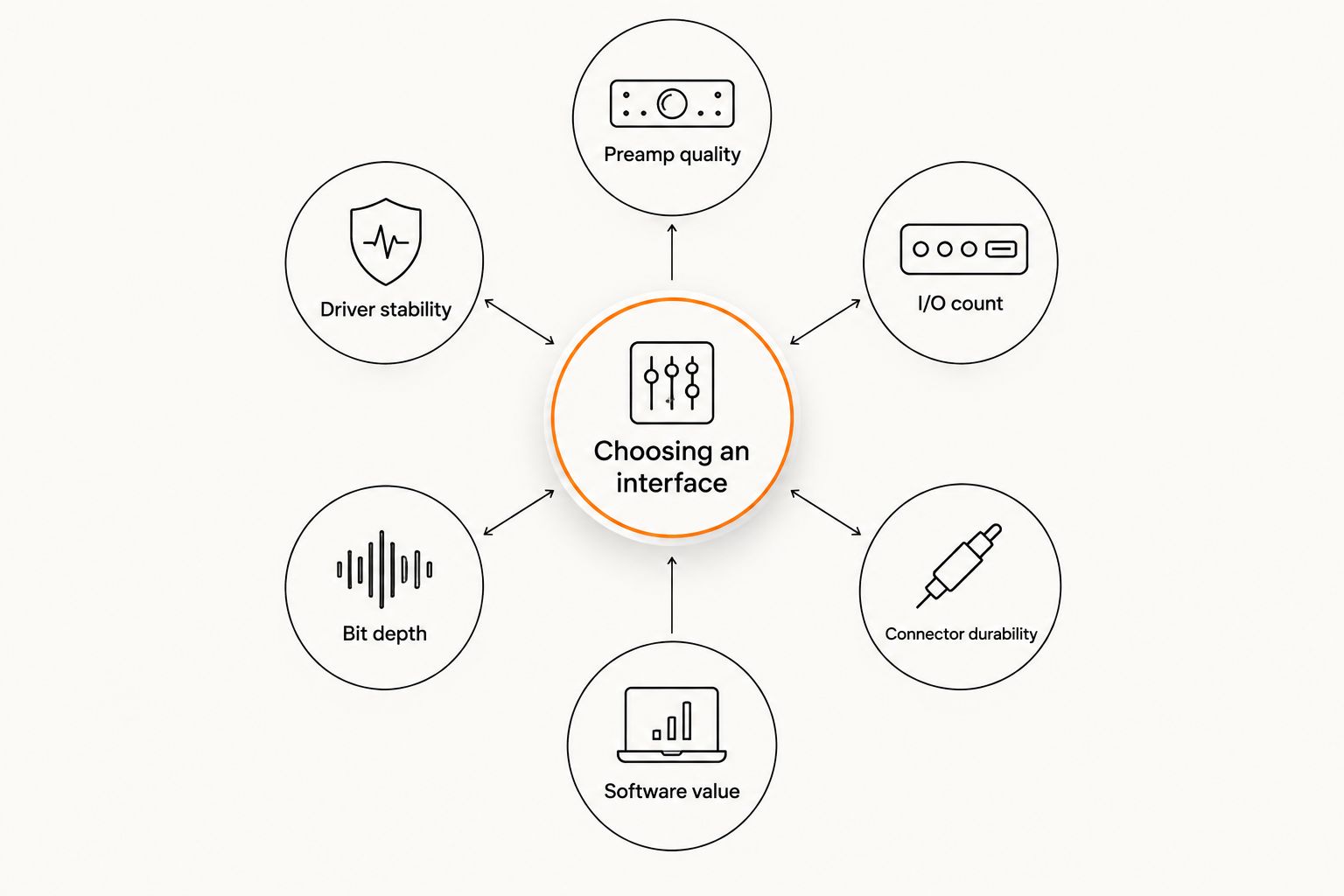
- Preamp quality and gain range — clean gain up to 55-60dB matters more for quiet vocalists and acoustic instruments than any plugin.
- Driver stability at low buffer sizes — a driver that stays solid at 64-128 samples keeps latency low enough to track live without a delay you can feel.
- I/O count matched to your sessions — two inputs cover a solo songwriter; a full band or multi-mic drum kit needs four or more.
- Bit depth and sample rate — 24-bit/192kHz gives more headroom for mastering later than a unit capped at 24-bit/48kHz.
- Connector durability — USB-C and Thunderbolt connections hold up better under daily plug/unplug than older USB-B ports.
- Bundled software value — a DAW license or plugin suite included with the interface offsets part of the cost of getting a session running.
Audio interfaces at a glance
| Interface | Best for | Standout feature | Key limitation |
|---|---|---|---|
| Focusrite Scarlett 2i2 (4th Gen) | Most home studios | Air mode adds top-end presence to vocals and acoustic guitar | Only 2 inputs — outgrown fast by band sessions |
| Universal Audio Volt 276 | Vocalists wanting analog character | Built-in vintage 76-style compressor per channel | Software suite is a bigger setup step than rivals |
| PreSonus Studio 24c | First-time producers on a budget | Simple 2-in/2-out layout with no learning curve | Preamps run out of clean gain on quiet sources |
| MOTU M2 | Mix monitoring | Onboard peak meter and ESS Sabre DAC | Only 2 mic preamps, same ceiling as entry units |
| Audient iD4 MkII | Solo songwriters | Built-in JFET DI for guitar and bass | Single headphone output limits group sessions |
| RME Babyface Pro FS | Touring and professional engineers | Rock-solid drivers, sub-3ms round-trip reputation | Steeper setup curve for a hobbyist just starting |
1. Focusrite Scarlett 2i2 (4th Gen): best audio interface for most home studios
The Scarlett 2i2 (4th Gen) is Focusrite's flagship 2-in/2-out interface and the unit most home studios default to in 2026. It runs on USB-C, includes two Focusrite mic preamps with Air mode for extra top-end clarity, and ships with a software bundle covering a basic DAW and a handful of plugins.
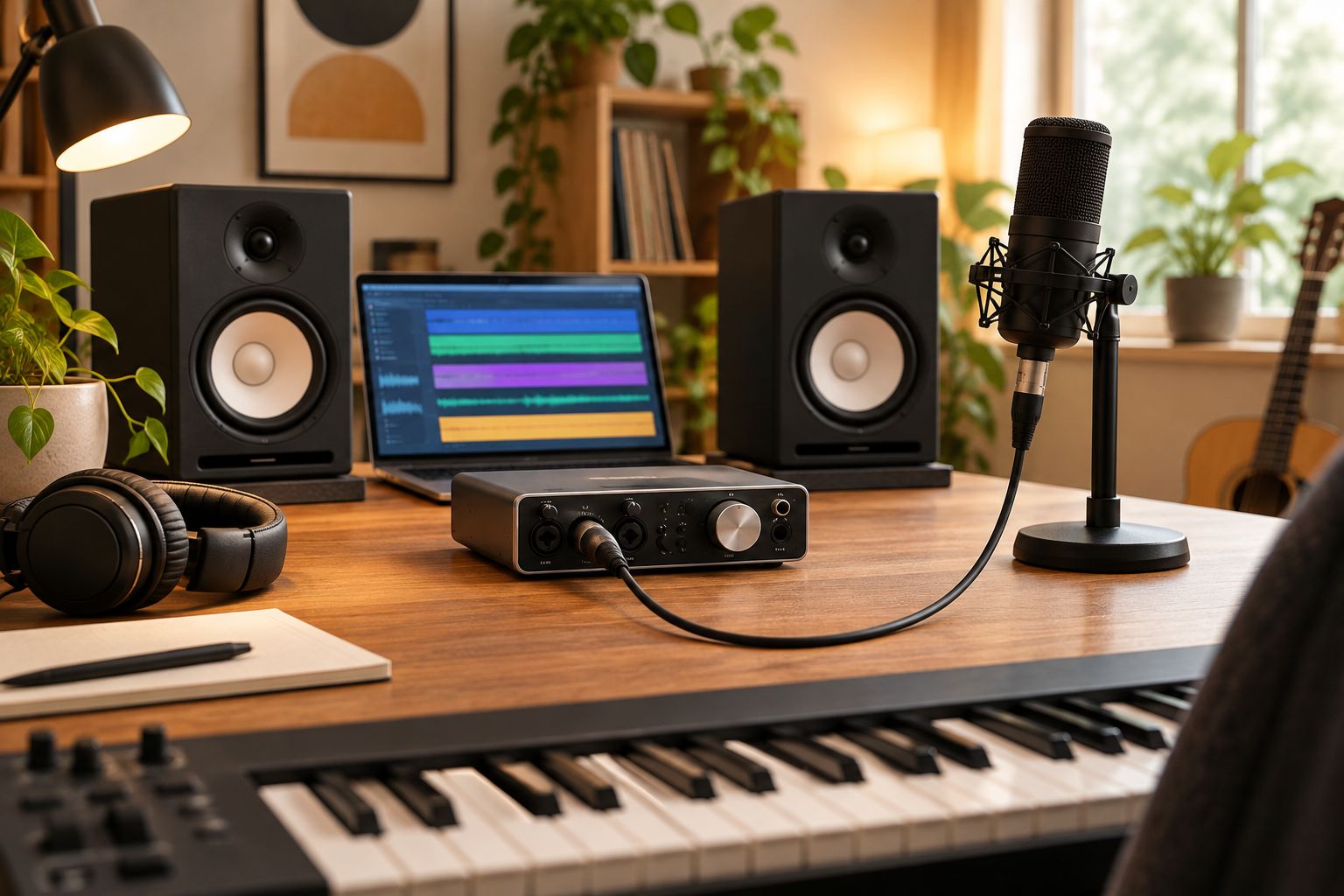
Focusrite Scarlett 2i2 pros:
- Air mode adds presence without needing an EQ plugin
- USB-C connection with bus power, no separate power supply
- Widely supported across DAWs with mature drivers
- Deep secondary market on OohYeah means replacement units are easy to find
Focusrite Scarlett 2i2 cons:
- Two inputs cap you at solo or duo tracking
- No MIDI I/O built in
- Headphone output isn't loud enough for some in-ear monitor setups
Pricing varies by condition and bundled accessories, so compare current listings before buying new or used. Best for: musicians who want one interface that handles vocals, guitar, and basic production without a learning curve.
Verdict: Buy.
2. Universal Audio Volt 276: best audio interface for vocalists
The Volt 276 pairs two mic preamps with Universal Audio's built-in vintage compressor and preamp emulation, switchable per channel. That's a meaningful difference for a vocalist tracking without outboard gear — you get shaped tone going into the DAW instead of relying entirely on post-production.
Universal Audio Volt 276 pros:
- Onboard vintage preamp and compressor modeling per channel
- 76-style compression emulation baked into the hardware path
- Includes a plugin bundle geared toward vocal and mix processing
Universal Audio Volt 276 cons:
- Software installation and account setup takes longer than plug-and-play rivals
- Only two inputs, same ceiling as budget units
- Vintage modeling won't suit engineers who want a fully transparent input
Best for: vocalists and singer-songwriters who want tone shaping at the source.
Verdict: Buy if vocal character matters more to you than a clean, neutral signal path.
3. PreSonus Studio 24c: best budget audio interface for home studios
The Studio 24c strips the feature list down to two clean mic preamps, USB-C connectivity, and a straightforward control panel. It's built for a first-time producer who needs a working signal path fast, not a deep menu of onboard processing.
PreSonus Studio 24c pros:
- Simplest setup of any interface on this list
- USB-C bus-powered, no extra cables
- Bundled DAW license gets a new producer recording same-day
PreSonus Studio 24c cons:
- Preamps run out of clean gain on quiet ribbon mics or soft vocalists
- No onboard DSP or hardware modeling
- Build feels lighter-duty than the Scarlett or Volt lineup
Best for: a first home studio where budget matters more than feature depth.
Verdict: Buy as a starter unit, then upgrade once your sessions outgrow two inputs.
4. MOTU M2: best audio interface for mix monitoring
The M2 puts a 2.4-inch peak meter directly on the front panel and runs its outputs through an ESS Sabre DAC, which gives a noticeably cleaner monitoring path than most interfaces at this tier. That matters more once you're mixing than while you're tracking. Compare it against used studio monitors if you're building a full monitoring chain, not just an interface.
MOTU M2 pros:
- Onboard peak meter shows input level without opening the DAW
- ESS Sabre DAC delivers a clean, accurate monitoring signal
- Loopback for streaming or recording internal audio
MOTU M2 cons:
- Still only 2 mic preamps
- No onboard DSP or hardware effects
- Software bundle is thinner than the Volt 276's
Best for: producers who spend more time mixing and monitoring than tracking live instruments.
Verdict: Buy if a visual meter and clean monitoring path matter to your workflow.
5. Audient iD4 MkII: best audio interface for solo songwriters
The iD4 MkII builds a JFET-based DI directly into channel two, so a songwriter tracking guitar or bass doesn't need a separate DI box on the desk. One mic preamp and one instrument-ready input cover most singer-songwriter sessions on their own.
Audient iD4 MkII pros:
- Built-in JFET DI removes the need for an external DI box
- Large, motorized volume control on the front panel
- Compact footprint fits a small desk setup
Audient iD4 MkII cons:
- Only one mic preamp, not enough for two vocalists at once
- Single headphone output
- Fewer total I/O than interfaces built for band sessions
Best for: a solo songwriter alternating between guitar, bass, and vocal takes in the same session.
Verdict: Buy for solo work; skip if you regularly record more than one performer at a time.
6. RME Babyface Pro FS: best audio interface for touring and professional engineers
The Babyface Pro FS carries a reputation among working engineers for drivers that hold up on tour and in client sessions where a crash isn't an option. It runs more inputs and outputs than the entry-level picks on this list and handles higher sample rates without the buffer issues that show up on cheaper hardware.
RME Babyface Pro FS pros:
- Driver stability that professional engineers rely on for client sessions
- Higher I/O count than the entry-level interfaces on this list
- Steady used-market resale value, since engineers hold onto RME gear or trade it directly
RME Babyface Pro FS cons:
- Overkill for a bedroom producer tracking one vocal at a time
- Smaller onboard DSP feature set than some UA hardware
- Setup and routing options take longer to learn than a plug-and-play unit
Best for: professional and touring engineers who need reliability over flashy onboard processing.
Verdict: Buy if you're working client sessions; wait if you're still tracking demos at home.
How we ranked these audio interfaces
Every pick above earned its spot on a distinct use case, not a repeated "best overall" slot: vocal character (Volt 276), monitoring accuracy (M2), solo songwriting (iD4 MkII), budget (Studio 24c), and professional reliability (Babyface Pro FS), with the Scarlett 2i2 as the default when none of those specific needs apply. Preamp quality, driver stability, and I/O count carried the most weight in 2026, since those three variables affect every session recorded on the unit.
Which audio interface should you choose?
If you don't fit one of the five specific use cases above, buy the Focusrite Scarlett 2i2 (4th Gen). It's the safest default for a home studio in 2026 — two clean preamps, USB-C, and wide DAW compatibility. Move to the Universal Audio Volt 276 or RME Babyface Pro FS only once you know exactly what gap you're filling.
Once you know which interface fits, gear resale on used studio interfaces cycles fast enough that a specific model usually shows up within weeks, not months. If you already own an interface and need someone to help set up a session around it, browsing to hire a music producer is the next move.
FAQ
What's the best audio interface for a home studio in 2026?
The Focusrite Scarlett 2i2 (4th Gen) is the best overall audio interface for a home studio in 2026 for most musicians. Pick the Universal Audio Volt 276, RME Babyface Pro FS, or another pick on this list only if your session needs a specific feature the Scarlett doesn't cover.
Is USB-C or Thunderbolt better for a home studio interface?
USB-C covers nearly every home studio need in 2026, including low-latency tracking at small buffer sizes. Thunderbolt only becomes worth the extra cost once you're running high channel counts or very low round-trip latency on a professional session.
How many microphone preamps do I need for a home studio?
Two mic preamps cover a solo songwriter or a duo tracking vocals and one instrument at a time. Move up to four or more preamps once you're recording a full band or a multi-mic drum kit in one pass.
Is a used audio interface a good buy for a home studio?
A used audio interface is a solid buy as long as the drivers still install cleanly on a current operating system. Interfaces have no moving parts to wear out, which is why models like the RME Babyface Pro FS hold resale value on marketplaces like OohYeah.
What determines the price of a home studio audio interface?
Input count, preamp quality, sample rate ceiling, and onboard processing like the Universal Audio Volt 276's compressor modeling all move the price up or down. Condition and included accessories shift the price further on the used market.
Do I need an audio interface if I just record vocals?
You need an audio interface if you're recording through an XLR microphone, since a USB mic skips the interface but limits you to one input and no analog preamp. A single-preamp unit like the Audient iD4 MkII covers solo vocal tracking without excess I/O.
What's the difference between an audio interface and a USB microphone?
An audio interface converts an analog signal from any XLR mic or instrument into digital audio your DAW can record, while a USB microphone has the converter built into the mic itself. Interfaces give more preamp and input flexibility; USB mics are simpler but less expandable.
How do I sell my old audio interface for the most money?
List the interface with its original cables and any bundled software license still active, since a complete kit sells faster than a bare unit. Selling through a marketplace like OohYeah keeps the full sale price with zero seller commission instead of losing a cut to a consignment fee.
One last thing
Most home studio producers don't replace their first interface because it broke — they replace it because their channel count outgrew it. Buy one extra input over what you need for your current sessions and you skip the second purchase entirely.