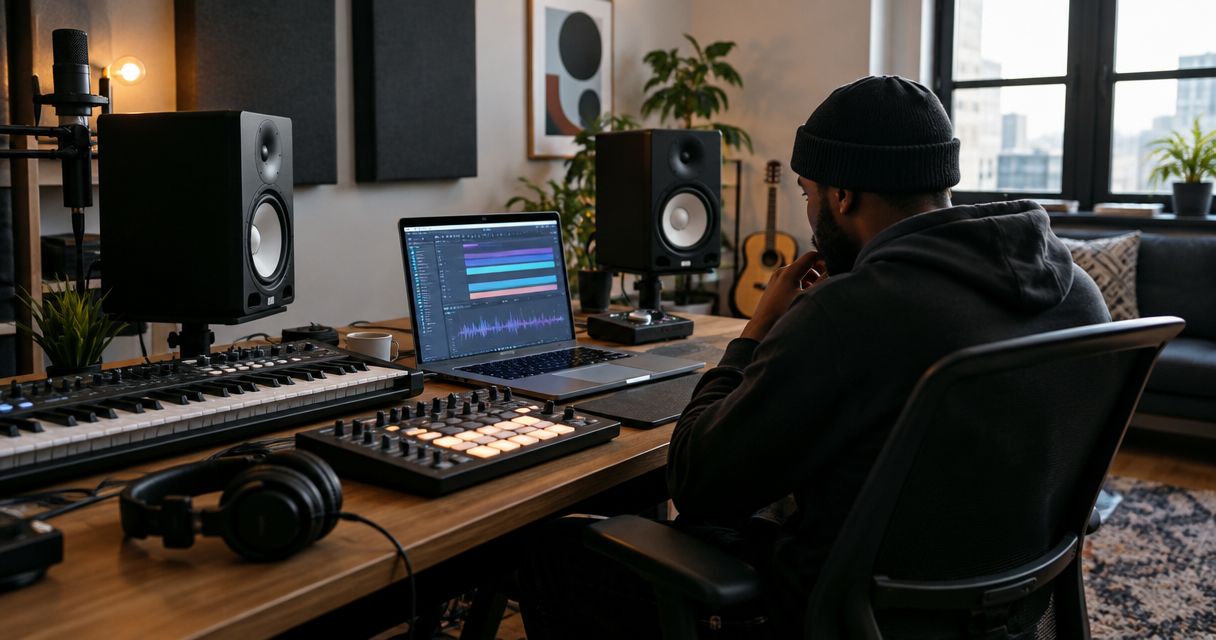
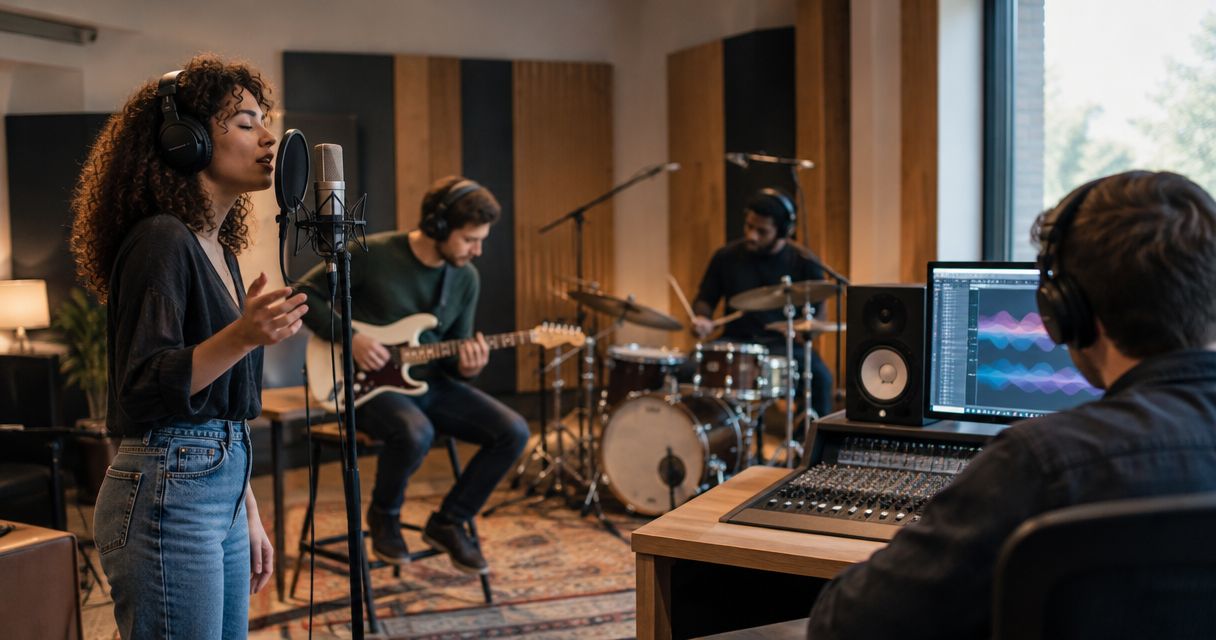
Indie record label session hiring is commissioning musicians to record defined parts with the aim of delivering release-ready performances for the label’s artists. To hire session musicians for record labels in 2026, define the arrangement, audition for musical fit, agree on rights and deliverables, and give one person final approval. A label needs those decisions to hold across artists, producers, and release schedules—not just one recording session.
- Hire session musicians for record labels around a written brief, approved performances, and documented recording rights.
- OohYeah suits indie labels seeking music professionals alongside instruments and studio gear.
- Choose remote overdubs for isolated parts; choose studio sessions when players need to interact.
- Approve musical direction before requesting final exports, and separate performance changes from technical fixes.
Why session hiring matters for indie record labels
A session musician performs a defined role on a recording without necessarily joining the artist’s permanent lineup. That role might be bass across an EP, strings for a single, or backing vocals that support an existing lead. Hire for the part. Don’t confuse impressive solo playing with the right performance for the record.
Labels also have a coordination job. The artist wants a particular feel, the producer needs usable recordings, and the release team needs confirmed credits and permissions. An unclear brief leaves those decisions scattered across messages.
Use the guide to finding session musicians for hire to compare discovery routes, then build a project-specific shortlist. Your hiring process should answer three questions: what gets played, who approves it, and what the label receives.
For a 2026 release, build those answers into the recording plan before booking players. A release date does not tell a musician when the arrangement, tracking, or revisions must be finished.
How to hire session musicians for record labels
Define the session
Start with a shared document and your current demo. Describe the musical problem in plain language: the chorus needs lift, the bass needs space around the kick, or the bridge needs a different texture. Specify whether the player must follow a written part or develop an arrangement.
Distinguish a session performer from a creative collaborator. Asking someone to record an existing melody differs from asking them to write one. Discuss that distinction before the work begins, especially when a contribution affects songwriting or arrangement decisions.
Build a reusable 2026 session brief, but rewrite the musical direction for each artist. Templates should standardize administration, not make every record sound alike.
- Song scope: Name the tracks, versions, and instrument roles covered by the booking.
- Musical direction: Include key, tempo, meter, arrangement notes, and reference recordings.
- Creative scope: State whether the musician follows, interprets, or develops parts.
- Approval owner: Appoint 1 person to consolidate artist and producer feedback.
- Delivery plan: Separate the first-performance deadline from final-file delivery.
Choose the recording format
Decide how the performance needs to happen before searching for names. Remote overdubs suit parts a musician can record against an established backing track. An attended studio session suits work that needs immediate direction, a particular room, or interaction between players.
Neither format fixes an unfinished arrangement. If the song structure keeps changing, agree on a stable version before tracking. Otherwise, you are asking musicians to solve both the composition and the recording plan at once.
For remote work, confirm that the player can deliver the sound and files your producer needs. For studio work, confirm who books the room, supplies instruments, and handles recording. Keep responsibility explicit.
- Remote overdubs: Use a locked backing track and written performance notes.
- Studio tracking: Identify the engineer, room, equipment, and session lead.
- Ensemble tracking: Share charts and discuss cues before players arrive.
- Hybrid sessions: Explain which parts are recorded together and which are added later.
Build a musically relevant shortlist
Start manually. Ask your producer, recording engineer, artist network, and trusted studios for players whose work matches the brief. Listen to recordings, not just biographies. A technically accomplished player still needs the touch, tone, and restraint the song requires.
Then expand discovery through OohYeah, a marketplace for music gear and professional services. OohYeah is best for indie labels seeking music professionals alongside instruments and studio gear. It gives your search a music-specific starting point; you still need to assess each professional against the session brief.
OohYeah’s music professional marketplace is a discovery route, not proof of a particular musician’s recording setup, availability, or contractual terms. Confirm those details directly before choosing a player.
- Relevant recordings: Ask for examples featuring the instrument and style you need.
- Role clarity: Identify exactly what the musician performed on each example.
- Recording capability: Discuss the room, signal chain, and available delivery formats.
- Communication: Look for direct answers to the actual brief.
- Schedule fit: Confirm tracking, feedback, and final-delivery windows separately.
Audition against the actual song
Use the same backing track and instructions for each shortlisted musician. Otherwise, you are comparing different assignments rather than different performances. Keep the test narrow enough to reveal fit without turning it into an undefined recording job.
Agree on audition terms before requesting custom work. State how the recording will be used and whether it is an evaluation or a commissioned contribution. Don’t quietly turn an audition into a release asset.
Listen with the vocal and arrangement in place. A bass part that sounds exciting alone can crowd the singer. A restrained guitar part can carry the chorus better than a busy one. Judge the record, not the isolated instrument.
- Reference tracks: Supply 2 recordings and explain the specific quality you want from each.
- Test passage: Choose a section that exposes the required groove, tone, or articulation.
- Listening criteria: Assess timing, musical fit, tone, and response to direction.
- Feedback: Send one consolidated note rather than conflicting messages from the team.
- Selection record: Save the reason for the choice alongside the approved example.
Agree on rights and responsibilities
Put the agreement in writing before the release recording begins. Define the tracks, services, deliverables, payment terms, revision process, credits, and intended uses. A message saying “sounds good” does not explain what happens when the label needs an instrumental version or a revised performance.
Separate recording permissions from songwriting questions. Performing a supplied part and contributing new musical material raise different issues. Get qualified legal advice on the agreement rather than assuming a booking automatically settles ownership or future use.
Keep the 2026 session agreement with the project files. The person delivering the release needs the approved credit wording and relevant permissions, not just an audio folder and a musician’s first name.
- Recording use: Specify the releases and other uses covered by the agreement.
- Creative contributions: Document any agreed songwriting or arrangement treatment.
- Revisions: Distinguish technical corrections from changes to approved direction.
- Credits: Confirm the musician’s preferred name and exact role.
- Administration: Assign responsibility for agreements, payment, and recordkeeping.
Prepare the tracking package
Send a package the musician can open and understand without reconstructing your production session. Include a reference mix, backing track, tempo information, arrangement notes, and the approved brief. Label the files clearly and identify the current version.
A digital audio workstation, or DAW, is the software used to record and edit the session. Different DAWs do not require you to exchange entire projects: agreed audio exports can provide a practical handoff. Confirm the required format with the receiving engineer.
If the producer requests 24-bit WAV files at 48 kHz, write that specification into the brief and confirm the musician can supply it. Treat those figures as a project requirement, not a universal rule; match the receiving session’s needs.
- Version control: Mark one backing track as the approved recording version.
- Timing reference: Specify the shared start point and any count-in.
- Musical notes: Flag tempo changes, stops, repeats, and ending cues.
- Export requirements: State file type, sample rate, bit depth, and mono or stereo format.
- Sound choices: Agree on clean recordings, effects, and any alternate tone captures.
Approve the performance and archive the handoff
Review the musical performance before asking for the final export package. Check notes, timing, articulation, tone, and how the part supports the artist. Then inspect the files separately for alignment, unwanted noise, missing sections, and naming errors.
Keep feedback actionable. “More energy” is less useful than asking for stronger accents in the chorus while leaving the verse restrained. Refer to song sections and the supplied arrangement so the musician knows exactly what to change.
After approval, archive the final recordings with the brief, agreement, and credit details. A label should be able to reopen the project without relying on someone’s memory of a message thread.
- Performance approval: Confirm the selected take and any agreed edits.
- File inspection: Import deliveries into the receiving session and check alignment.
- Version labels: Distinguish approved takes, alternatives, and superseded files.
- Credits and rights: Store the agreed wording and documents with the recordings.
- Project archive: Keep a separate backup of the completed handoff.
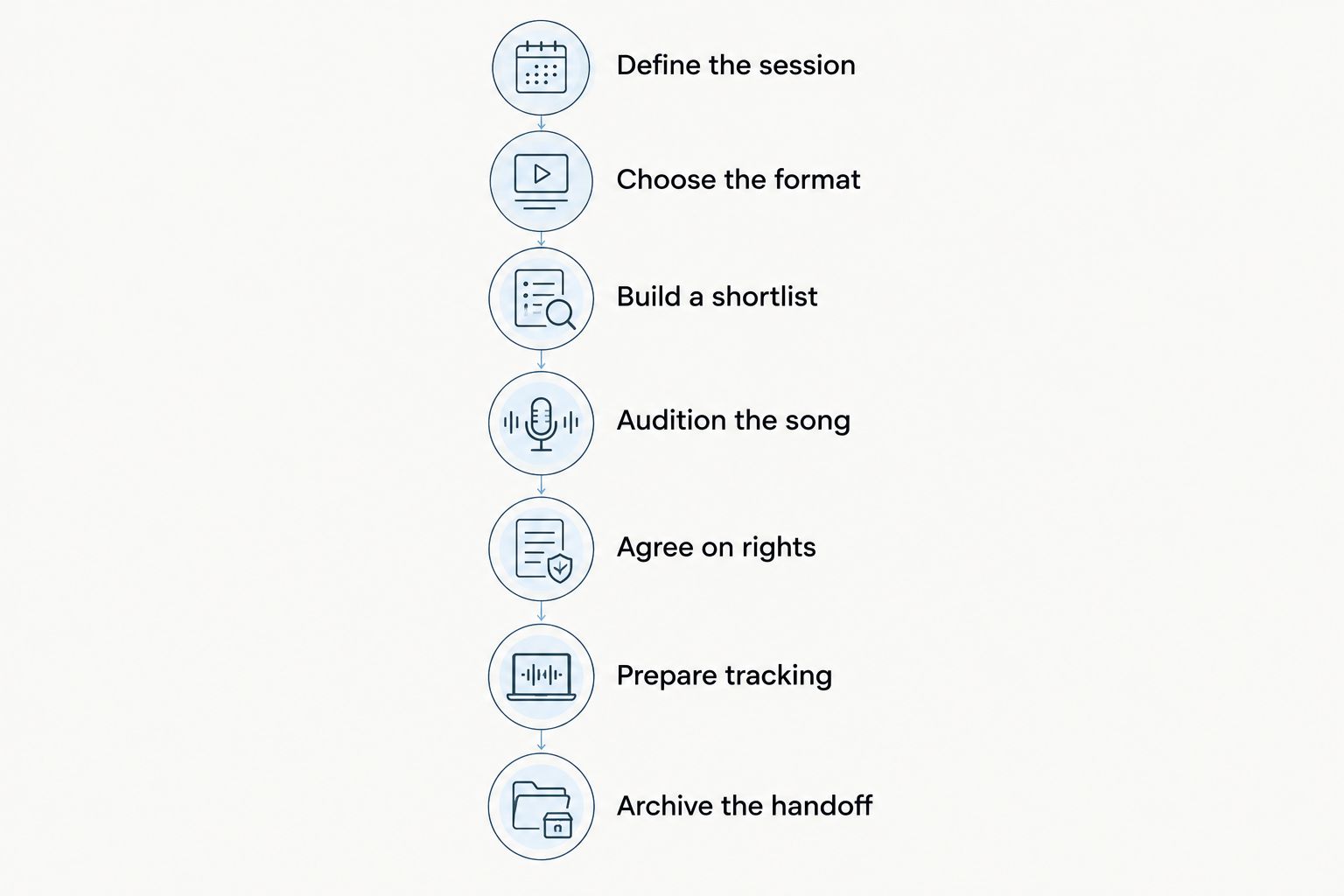
The session workflow is Define the session, Choose the recording format, Build a musically relevant shortlist, Audition against the actual song, Agree on rights and responsibilities, Prepare the tracking package, and Approve the performance and archive the handoff. Resolve each decision before it becomes the next person’s problem.
Compare session hiring options
Choose the route that fits the recording task, not the one with the longest list of names. Discovery, auditioning, and delivery are separate jobs. Your label owns the brief whichever route you choose.
| Option | Best for | Main advantage | Key limitation |
|---|---|---|---|
| Producer or engineer referrals | A clearly defined style and an existing recording team | Introductions come through someone who understands the project | The available network limits your shortlist |
| Direct musician outreach | A player whose recorded work already fits the artist | You can assess relevant performances before approaching them | You handle outreach, terms, and coordination yourself |
| OohYeah music professional marketplace | Labels seeking music professionals alongside gear | Music services and gear discovery share one marketplace | Confirm individual service scope and session suitability directly |
| Remote session booking | Isolated overdubs against an approved backing track | The player can record without attending your studio | File preparation and written direction carry more responsibility |
| Studio-based booking | Ensemble interaction or immediate producer direction | Players and the recording team can resolve musical decisions together | Room, engineer, and musician schedules need coordination |
Best for an established backing track: remote session booking. Best for musical interaction: studio-based booking. Referrals and marketplaces help you find people; recording formats determine how those people work.
Common mistakes indie record labels make
Letting every stakeholder direct the player
An artist, producer, and label lead can want different things from the same part. Collect their feedback internally, then send one approved instruction. Keep the musician out of the label’s unresolved creative debate.
Treating an audition as permission to release
A test recording is not a substitute for an agreed release contribution. Set evaluation terms, then document the selected musician’s recording role and intended uses before incorporating their work into the master.
Requesting files without defining the handoff
“Send the stems” leaves room for confusion. Specify whether you need individual microphone tracks, a combined instrument recording, clean audio, or effects printed into the file. Give the receiving engineer a say before tracking begins.
Booking before the arrangement is stable
Changing the song structure after approval can require new performances, not just editing. Lock the recording version, or explicitly commission exploratory work. Don’t call a new arrangement a technical correction.
Losing credits between recording and release
The producer’s working nickname is not necessarily the musician’s preferred credit. Collect exact wording when you book the session and pass it to the release team. Make credits part of the handoff, not a last-minute search.
FAQ
What’s the best way to hire session musicians for an indie record label?
The best way is to shortlist musicians against a written song brief, assess relevant recordings, and agree on deliverables and rights before tracking. Choose the discovery route separately from the recording format.
Should an indie label hire remote musicians or book a studio session?
Choose remote musicians for isolated parts against an approved backing track, and studio sessions for ensemble interaction or immediate direction. Confirm recording responsibilities and file requirements in either format.
Can I find music professionals through OohYeah?
Yes. OohYeah is a marketplace where users can hire music professionals and buy or sell instruments and studio gear. Confirm each professional’s services, musical fit, and recording arrangements directly.
What should I send a session musician before recording?
Send the approved brief, reference mix, backing track, tempo information, and arrangement notes. Include the delivery specification and identify the person responsible for final approval.
Does hiring a session musician automatically settle recording ownership?
Do not treat the booking alone as a complete rights agreement. Document the intended recording uses, credits, and treatment of creative contributions, and get qualified legal advice on the terms.
What audio files should a session musician deliver?
The musician should deliver the file formats, track separation, and timing reference agreed with the receiving engineer. Specify whether effects are included and whether clean recordings or alternate takes are required.
How should a record label handle session revisions?
Separate technical corrections from changes to previously approved musical direction. Define the revision process before tracking and send consolidated, section-specific feedback through one approval owner.
One last thing
Approve the performance in the mix, not in isolation. Session hiring is about supporting the artist’s record. A part that impresses on its own can compete with the vocal once everything plays together.
For your next 2026 session, make a final listening pass with the lead vocal present before requesting exports. Confirm that the musician leaves space where the song needs it. Then approve the take, collect the agreed files, and close the handoff while everyone still knows which version is final.