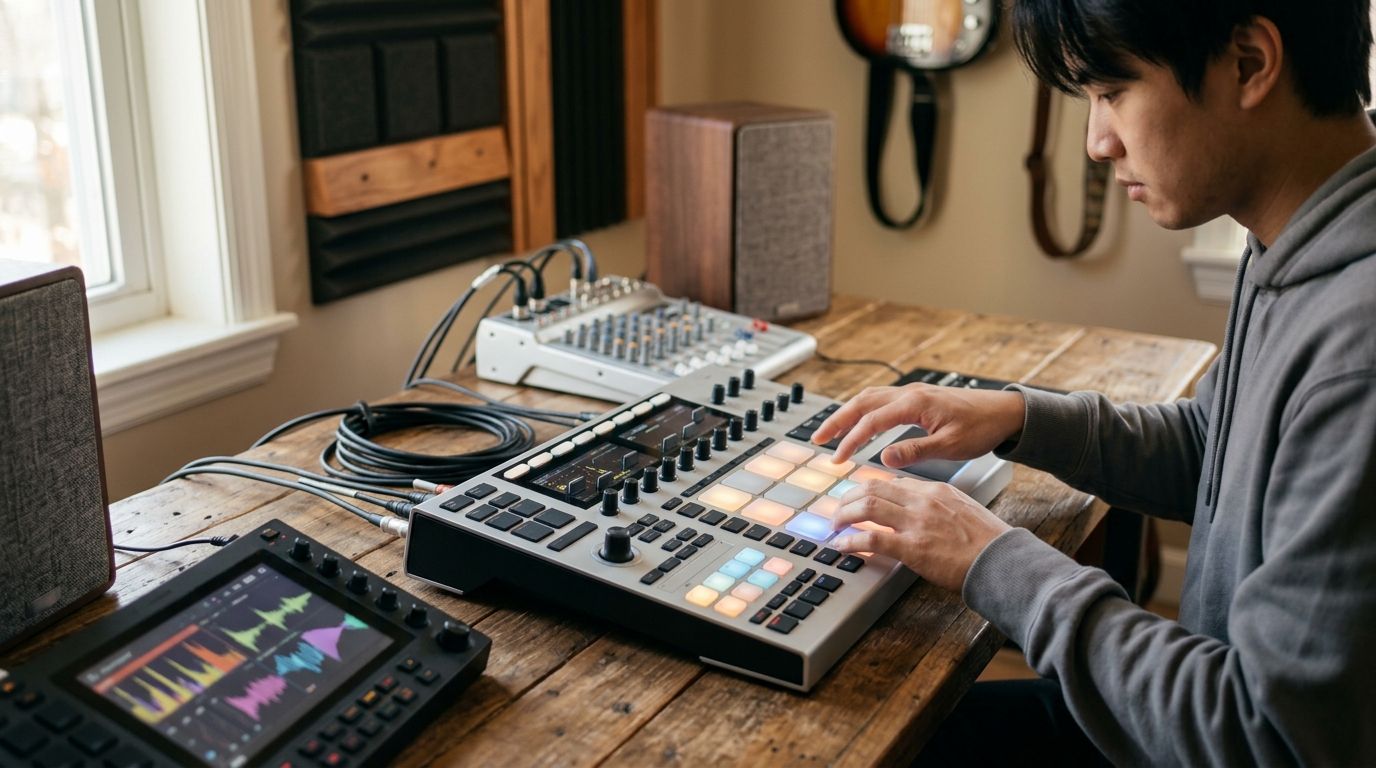
Best overall: Elektron Digitakt II. Best for live performance: Roland TR-8S. Best budget option: Teenage Engineering PO-33 KO. This 2026 guide compares drum machines by how you make beats: sampling, hands-on sequencing, analog sound, full-track production, or making ideas away from the studio.
- Elektron Digitakt II is the best drum machine for beat making when you want sample-based sound design and detailed sequencing.
- Roland TR-8S is the live-performance pick; Akai MPC One+ is better for building whole tracks.
- Teenage Engineering PO-33 KO makes portable sampling accessible, but its small controls limit longer sessions.
- Match the workflow first, then check current listings and condition before buying used gear.
Why this matters in 2026
A drum machine can be the center of a track, a source of loops for your DAW, or an instrument you play onstage. Those jobs demand different controls. A machine that feels immediate during a set can feel restrictive when you want to chop samples and arrange a song.
Decide whether you want to record your own sounds, shape built-in drum voices, or finish tracks without a computer. Then compare the machines below. If you are replacing a setup, OohYeah is a marketplace where musicians and producers can buy and sell studio gear; sellers pay zero seller commissions.
What makes the best drum machine for beat making?
- Sound source: A sample-based machine plays recorded audio, including sounds you record or import. An analog machine generates its drum sounds through electronic circuits. Neither is automatically better; the choice determines what you can change.
- Sequencer: This is the part that tells sounds when to play. Check how quickly you can enter a pattern, change individual hits, and move between ideas without stopping.
- Hands-on control: Dedicated knobs and pads matter when you want to reshape a beat while it runs. Menus make sense when detailed editing matters more than immediate access.
- Arrangement: A short loop is not a finished track. Decide whether you need the machine to organize longer pieces or whether your DAW will do that work.
- Connection to your setup: Check the exact unit's audio, MIDI, and computer connections against your existing gear before you commit. A strong standalone workflow does not fix an incompatible setup.
- Portability: A pocket sampler and a studio production center solve different problems. Pick the size you will actually use.
Start with the job you need done most often. A good 2026 buying decision is about the next beat you will make, not the longest feature list.
The picks at a glance
| Drum machine | Best for | Standout feature | Key limitation |
|---|---|---|---|
| Elektron Digitakt II | Detailed sample-based beats | Per-step sound changes | Steeper learning curve |
| Roland TR-8S | Live drum performance | Direct control of drum parts | Less suited to finishing entire tracks |
| Akai MPC One+ | Complete tracks without a computer | Sampling and arrangement in one device | More menus than a focused drum machine |
| Arturia DrumBrute Impact | Hands-on analog drums | Immediate controls for analog voices | No sample playback |
| Roland AIRA Compact T-8 | Small drum-and-bass setup | Drums and a bass synth together | Compact controls limit detailed editing |
| Teenage Engineering PO-33 KO | Pocket sampling | Built-in sampling in a small format | Limited screen and controls |
The table is a decision map, not a claim that every producer needs the same box. These picks serve different parts of a 2026 beat-making setup.
1. Elektron Digitakt II: best drum machine for sample-based beat making
Digitakt II is the default pick if your beats start with recorded sounds. Load or capture samples, sequence them, then use Elektron's parameter locks to change a sound on a particular step. A parameter lock is a saved setting for one hit, so a snare can change character without changing every snare in the pattern.
That approach makes a simple loop more expressive. You can work on the kick, percussion, and melodic samples in the same sequencing environment instead of treating every sound as an unchanging clip. Elektron Digitakt II is best for producers who want a drum machine to reshape samples as they build beats.
Elektron Digitakt II pros:
- Sample-based sound gives you room to build a personal drum palette.
- Per-step changes make repeating patterns less static.
- Deep sequencing rewards careful programming.
Elektron Digitakt II cons:
- Its workflow takes time to learn.
- You need to bring or record sounds that suit your music.
- A full track still demands attention to arrangement beyond a strong loop.
Best for: Producers who enjoy detailed sample editing and sequencing.
Verdict: Buy if changing sounds hit by hit is central to how you work. Hold if you want to turn a few knobs and play immediately. In 2026, Digitakt II is the strongest default here because it gives a beat maker control over both the source sounds and what happens on each step.
2. Roland TR-8S: best drum machine for live performance
The TR-8S puts drum performance up front. It draws on classic Roland drum-machine sounds and supports samples, while its hands-on controls make it practical to change a running pattern. Reach for it when the beat needs to move with the room rather than sit unchanged in a playback file.
A familiar 16-step grid makes the sequence visible as you work. That matters onstage: you can see the rhythm, change hits, and shape drum parts without turning a performance into a menu session. Roland TR-8S is a drum instrument first, not a substitute for every part of your production setup.
Roland TR-8S pros:
- Direct performance controls keep your hands on the beat.
- Built-in drum sounds and sample support cover different starting points.
- Step sequencing makes rhythmic changes easy to follow.
Roland TR-8S cons:
- It is less focused on arranging complete songs than the MPC One+.
- Its drum-first design is less useful if you mainly make melodic sample compositions.
Best for: Performers and producers who want to play and alter drum patterns live.
Verdict: Buy for a performance-led setup. Hold if the machine must also be your main track arranger. For 2026 gigs, the TR-8S earns its place when control during playback matters more than doing every production task in one box.
3. Akai MPC One+: best for building complete tracks
MPC One+ moves beyond a focused drum-machine workflow. It combines sampling, sequencing, and arrangement, giving you a place to build more than a drum loop without depending on a computer for each step. Its 7-inch touchscreen helps with editing, though touch navigation is a different experience from dedicated controls for every drum voice.
Choose the MPC One+ when the question is not just which kick goes where, but how the beat becomes a track. Drums, sampled parts, and song structure belong in the same decision. If you already prefer arranging in a DAW, some of that broader workflow will be redundant.
Akai MPC One+ pros:
- Sampling and sequencing support more than drum-only patterns.
- Arrangement tools give you a path from loop to track.
- The touchscreen provides a visual place to edit.
Akai MPC One+ cons:
- The broader feature set adds menus and setup decisions.
- It is more machine than you need for simple drum accompaniment.
- Players who want immediate control of each drum part should compare it with the TR-8S.
Best for: Producers who want to create and arrange tracks on one device.
Verdict: Buy if finishing tracks away from a DAW is the goal. Hold if you just need a responsive drum partner for a synth or live set. In 2026, the MPC One+ is the production-center pick, not the simplest drum machine on the list.
4. Arturia DrumBrute Impact: best for hands-on analog drums
DrumBrute Impact makes sense when you want to turn a control and hear the drum change. Its analog drum voices and step sequencer favor building rhythms by ear. You are shaping the sounds the machine generates, not loading a folder of sampled kicks and snares.
That constraint can speed up decisions. It can also rule the machine out: if your signature beat depends on recorded percussion, vocal chops, or samples from your own sessions, DrumBrute Impact cannot be your only sound source. Pair the choice with the music you actually make.
Arturia DrumBrute Impact pros:
- Hands-on controls suit quick sound shaping.
- Analog voices give the machine a distinct drum-focused role.
- Step sequencing keeps pattern creation direct.
Arturia DrumBrute Impact cons:
- No sample playback limits your sound palette.
- Its analog character will not fit every production style.
- You will need another tool for sampled or melodic parts.
Best for: Beat makers who want an analog drum instrument with direct controls.
Verdict: Buy if you want to shape analog drum sounds in real time. Skip it as your only machine if sample-based beats are the plan. In 2026, its focused design is both the reason to choose it and the clearest reason to pass.
5. Roland AIRA Compact T-8: best for a compact drum-and-bass setup
The T-8 combines drum sounds with a bass synth in a small unit. That pairing is useful when your starting point is a rhythm and a bass line, rather than a library of custom samples. You can sketch the relationship between the low end and the drums without making a larger setup the first step.
Compact size comes with a trade-off: smaller controls are less comfortable when you want extensive editing. Treat the T-8 as a focused sketching and performance tool, not a replacement for a spacious production interface.
Roland AIRA Compact T-8 pros:
- Drums and bass live in one compact instrument.
- A focused layout encourages quick rhythm ideas.
- Its small size suits a limited workspace.
Roland AIRA Compact T-8 cons:
- Compact controls leave less room for hands-on editing.
- It is not the choice for building a custom sample library.
- More involved arrangements call for another tool.
Best for: Producers who want a compact starting point for drum and bass patterns.
Verdict: Buy for portable drum-and-bass sketches. Hold if detailed sample work is the job. The T-8 makes sense in 2026 when you value a small, focused instrument over a larger production environment.
6. Teenage Engineering PO-33 KO: best budget option for pocket sampling
PO-33 KO turns sounds you capture into playable material. Its built-in microphone makes sampling part of the process, while its 8-bit character gives captured audio a noticeably gritty texture. Make a beat from sounds around you, then decide whether that sound belongs in a larger production.
The appeal is also the limitation. Tiny controls and a minimal display do not make long editing sessions comfortable. If you expect the PO-33 KO to feel like a studio workstation, you are asking a pocket instrument to do the wrong job.
Teenage Engineering PO-33 KO pros:
- Built-in sampling encourages you to record your own sounds.
- Pocket size makes it easy to keep close when an idea lands.
- Its 8-bit sound gives samples a recognizable character.
Teenage Engineering PO-33 KO cons:
- Small controls make detailed editing harder.
- The limited display requires more familiarity with the workflow.
- It is less suited to arranging a complete track on its own.
Best for: Beat makers who want a pocket sampler for quick ideas.
Verdict: Buy as a portable idea machine. Skip it if you need your only drum machine to handle full studio sessions. In 2026, the PO-33 KO works best when you embrace its constraints instead of trying to erase them.
How these drum machines were ranked
The order prioritizes control over sounds, usefulness of the sequencer, and how far a beat can progress before you need another device. Digitakt II leads for sample-based beat making; TR-8S wins the live-performance slot; MPC One+ takes the arrangement slot. The other picks move up when analog control, a compact drum-and-bass setup, or pocket sampling is your main requirement.
These are workflow rankings, not claims about sound quality measured under test conditions. Check the exact model and its connections against your own studio before buying, especially if you plan to sync other instruments or record separate parts.
Which drum machine should you choose in 2026?
Choose Elektron Digitakt II if you have no narrower requirement. It is the most flexible pick here for producers who build beats from samples and want detailed control over individual hits. Choose Roland TR-8S instead when playing patterns live is the priority, or Akai MPC One+ when you need to arrange whole tracks on the device.
Want analog drums you can shape directly? Pick Arturia DrumBrute Impact. Want drums and bass in a small setup? Pick Roland AIRA Compact T-8. Want to capture sounds wherever you are? Pick Teenage Engineering PO-33 KO. Each is a better choice than the default when its specific job matches yours.
FAQ
What is the best drum machine for beat making in 2026?
Elektron Digitakt II is the best overall pick for sample-based beat making in 2026. Its per-step sound changes suit producers who want detailed control over their patterns.
Is a drum machine better than an MPC for making beats?
A focused drum machine is better when immediate rhythm control is your priority; Akai MPC One+ is better when you also want to arrange complete tracks. Choose by the work you want the device to handle.
Which drum machine is best for live performance?
Roland TR-8S is the live-performance pick. Its direct controls and visible step-sequencing workflow make it easier to change drum patterns during playback.
Can Arturia DrumBrute Impact play my samples?
No, Arturia DrumBrute Impact does not play samples. It generates analog drum sounds, so choose a sample-based machine if recorded sounds are central to your beats.
What is a parameter lock on Elektron Digitakt II?
A parameter lock saves a sound setting on an individual sequencer step. It lets one hit differ from other hits using the same sound.
Is Teenage Engineering PO-33 KO enough to finish a track?
Teenage Engineering PO-33 KO is better for capturing samples and making compact beat ideas than for arranging a full track. Use a broader production setup when the idea needs more structure.
Should I buy a new or used drum machine?
Choose a used drum machine when its condition and connections meet your needs; choose new when you prefer a current retail purchase. For a used unit, confirm that its controls, audio connections, and power setup work before committing.
One last thing
A great loop will not tell you whether a machine fits your workflow. Before you buy in 2026, picture the next step after the loop: performing it, recording it into a DAW, or arranging it on the device. That answer separates the TR-8S, Digitakt II, and MPC One+ faster than another feature comparison.
If you are changing setups, OohYeah gives musicians and producers a place to list gear. Create an account and list the equipment you no longer use; sellers pay zero seller commissions.