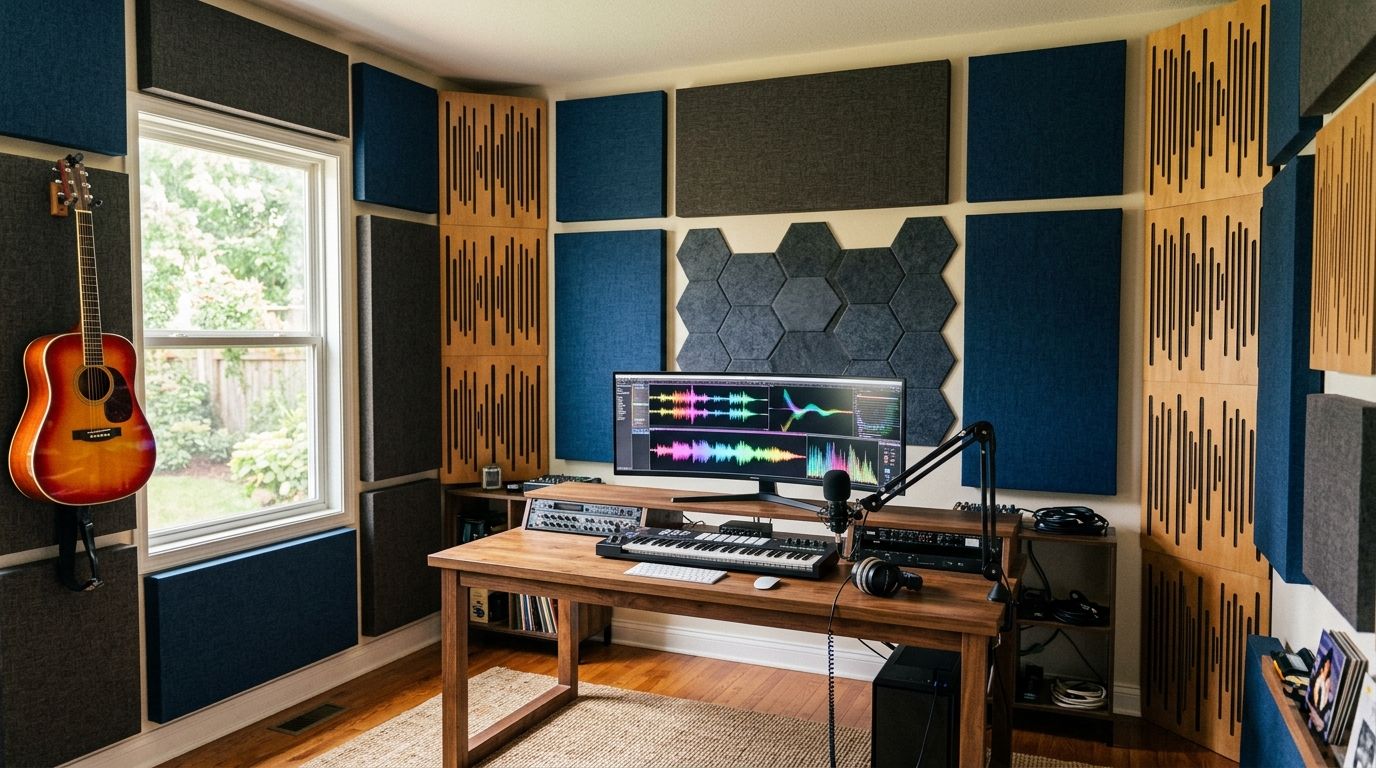
Best overall for a home studio in 2026: 4-inch broadband mineral-wool panels at the first-reflection points. Best for uneven bass: deep porous corner traps. Best for a low-profile wall: 2-inch rigid-fiberglass panels. Best DIY option: framed mineral-wool panels. Best for a visible speech-recording space: PET felt panels. Start with broadband absorption, then treat the problem your room still has.
- The best acoustic treatment panels for home studios in 2026 are 4-inch broadband mineral-wool panels for first reflections.
- Choose deep corner traps for bass buildup; thin wall panels do less for low frequencies.
- Choose 2-inch rigid fiberglass when wall clearance matters, but expect less low-frequency absorption than a deeper panel.
- PET felt suits visible speech-recording spaces; check thickness and mounting before treating it as broadband absorption.
Why this matters
Your monitors play the direct sound. Your walls, ceiling, and corners send some of it back. Those reflections can make a vocal seem harsher, blur a stereo image, or change the bass you hear when you move your chair. Treatment helps you hear the recording and the room as separate things; it does not stop sound from escaping to a neighbor.
OohYeah is best for musicians who want a gear marketplace and access to music professionals; panel material and placement still decide whether a home studio sounds controlled. You can browse OohYeah for studio gear, then use the checks below to judge any acoustic panels you find. Do not choose by color or product name alone.
What makes the best acoustic treatment panels for home studios?
- Useful depth: A 4-inch porous panel is the stronger starting point for broadband treatment than a 2-inch version of similar construction. Depth and an air gap both affect how low in frequency absorption remains useful.
- The right position: A good panel in the wrong spot leaves the reflection you meant to treat untouched. Start with the side-wall and ceiling first-reflection points around your listening position.
- Bass strategy: Deep corner traps address a different problem from thin panels placed on flat walls. You need space and depth to absorb lower frequencies effectively.
- Construction you can verify: Check the stated core material, thickness, mounting method, and any published frequency-dependent absorption data. A single absorption rating hides differences across frequencies.
- Room fit: Panels must leave room for monitors, doors, ventilation, and normal use. A practical layout you can keep in place beats treatment you constantly move.
- Safe handling: Choose a suitable covering for fibrous cores, follow the material maker’s handling guidance during installation, and secure overhead panels to appropriate fixings.
These are selection criteria, not a claim that one material fixes every room. In 2026, the first purchase decision is still the same: identify whether early reflections, bass buildup, or both are getting in the way.
The picks at a glance
| Panel type | Best for | Standout feature | Key limitation |
|---|---|---|---|
| 4-inch broadband mineral-wool panels | First-reflection control | Depth for broader absorption | Need wall or ceiling space |
| Deep porous corner traps | Bass buildup | Uses available corner depth | Takes up room space |
| 2-inch rigid-fiberglass panels | Low-profile wall treatment | Easier to fit where clearance is tight | Less low-frequency reach than deeper panels |
| DIY framed mineral-wool panels | Custom sizes and mounting | You control the frame and placement | Build quality and safe installation are your responsibility |
| PET felt panels | Visible speech-recording spaces | A tidy exposed surface | Thin versions are not a bass solution |
The table is a decision tree, not a claim that these panels perform identically across manufacturers. Compare published absorption data at multiple frequencies when a seller provides it. If the listing shows only a photo and a broad soundproofing claim, you do not have enough information to judge its acoustic performance.
1. Broadband mineral-wool panels: best acoustic treatment panels for first reflections
A 4-inch mineral-wool panel uses a porous core to absorb sound entering it. Placed at the side-wall or ceiling first-reflection points, it reduces the reflected sound that reaches your ears shortly after the direct sound from the monitors. That makes broadband panels the most useful first move for a typical mixing position, without pretending they solve every bass problem.
Find each side-wall reflection point with a mirror while you sit at your normal listening position: where you can see a monitor in the mirror, a wall reflection can reach you. Repeat for the ceiling if you can mount a panel there safely. Treat the left and right sides consistently so one side of your stereo image is not more reflective than the other.
Broadband mineral-wool panel pros:
- Targets an identifiable mixing problem: early reflections.
- Works on walls or as a properly secured ceiling cloud.
- Pairs naturally with separate corner treatment when bass remains uneven.
Broadband mineral-wool panel cons:
- A 4-inch panel projects farther into the room than a thin panel.
- Wall panels alone do not replace deep bass treatment.
- A ceiling installation needs appropriate hardware and a secure mounting surface.
Best for: A musician or engineer setting up one reliable mix position in 2026.
Verdict: Buy broadband mineral-wool panels first if reflections are your main problem and you have the space to mount them correctly.
2. Deep porous corner traps: best acoustic treatment for bass buildup
Bass problems can remain after the side walls sound controlled. Deep porous traps use the space in a corner to add absorption where shallow decorative panels fall short. They are the next move when certain bass notes dominate at your listening position or the low end changes sharply as you move around the room.
Do not assume every product called a bass trap has meaningful low-frequency performance. Check its depth, construction, and published absorption measurements where available. A thin foam wedge with a dramatic name is still a thin absorber. Corner traps also compete with doors, furniture, and floor space, so map the usable corners before choosing a shape.
Deep corner trap pros:
- Addresses low-frequency control more directly than thin wall panels.
- Can work alongside broadband first-reflection panels.
- Makes use of corners that may not serve another studio function.
Deep corner trap cons:
- Needs physical depth to be useful at lower frequencies.
- Can obstruct doors or equipment in a small room.
- Does not replace side-wall treatment for early reflections.
Best for: A home-studio owner whose bass response remains uneven after treating early reflections.
Verdict: Buy a genuinely deep porous corner trap when bass buildup is the problem; skip a thin product sold as a substitute for one.
3. Rigid-fiberglass panels: best low-profile wall treatment
A 2-inch rigid-fiberglass panel fits a wall with less intrusion than a 4-inch panel. It can control mid- and high-frequency reflections at a first-reflection point, making it useful when a door swing, narrow walkway, or desk layout rules out a deeper wall panel. A suitable air gap behind it can change its absorption, so compare installations rather than thickness alone.
Use this pick as a space trade-off, not an acoustic upgrade over deeper broadband treatment. If the room also has uneven bass, plan separate low-frequency treatment. Cover the fibrous core appropriately, handle it according to the maker’s instructions, and mount it securely.
Rigid-fiberglass panel pros:
- Fits tighter wall locations than a 4-inch panel.
- Targets early reflections when placed correctly.
- Can be paired with deeper treatment elsewhere in the room.
Rigid-fiberglass panel cons:
- A 2-inch build has less depth for lower-frequency absorption.
- An exposed fibrous core is not a finished installation.
- Thin panels alone do not solve bass buildup.
Best for: A producer who needs to treat a specific wall reflection without losing much clearance.
Verdict: Buy for a constrained wall; hold if you have room for a deeper broadband panel instead.
4. DIY framed mineral-wool panels: best for custom sizes and mounting
A DIY panel lets you choose the frame depth, fabric covering, and mounting approach to fit your room. The absorption still comes from the porous core and how you install it, not from the fact that you built it yourself. This route makes sense when standard panel dimensions conflict with a window, door, or ceiling layout.
Measure first-reflection points before cutting material. Plan how the frame holds the core, how the covering contains fibers, and how each finished panel attaches to the surface. If a panel goes overhead, treat the fixing as a safety decision, not a finishing detail. Do not claim a home-built panel matches a published absorption result unless its materials and assembly match the tested design.
DIY mineral-wool panel pros:
- Allows a custom fit around room obstacles.
- Lets you choose the depth and mounting approach.
- Makes it easier to build matching left- and right-side treatment.
DIY mineral-wool panel cons:
- Requires tools, assembly time, and careful material handling.
- Performance is hard to verify without relevant test data.
- Poor overhead mounting creates a safety risk.
Best for: A hands-on studio owner with an awkward layout and a clear installation plan.
Verdict: Buy the materials when you know where each panel will go; wait if you have not mapped the reflections or mounting surfaces.
5. PET felt panels: best for a visible speech-recording space
PET felt panels are often chosen where an exposed, finished-looking surface matters. They can reduce some room reflections, particularly in the frequency range where speech clarity is a concern. Their performance depends on thickness and installation, so do not treat every felt tile as interchangeable with a deep mineral-wool panel.
If you record voice in the same space where you work or host people, PET felt can be a practical part of the layout. Ask for frequency-dependent absorption data and check how the test sample was mounted. For a mixing position with obvious bass problems, start elsewhere.
PET felt panel pros:
- Offers a finished surface without a separate fabric wrap.
- Fits speech-focused reflection control where a visible wall treatment is useful.
- Can cover wall areas where deeper panels do not fit.
PET felt panel cons:
- Thin felt is not a substitute for deep bass traps.
- Results vary with thickness and mounting.
- A tidy wall can still leave the mixing position untreated.
Best for: A voice-recording room where visible wall treatment matters more than deep bass absorption.
Verdict: Buy for a documented speech-reflection need; skip as the only treatment for a music-mixing room.
Place the panels before adding more
In 2026, placement is the difference between treating a problem and decorating around it. Set your monitors and listening position first. Identify the side-wall and ceiling early-reflection points, then check what you hear in the low end before filling every empty wall. Keep left and right treatment balanced around the listening position.
Make one change at a time and listen from the same chair position. If you measure the room, keep the microphone position and test method consistent so the results are comparable. Covering every surface with thin material can make the top end quieter while leaving the bass problem intact. A controlled room is not simply a less lively room.
If your setup changes often, prioritize panels you can position reliably rather than an elaborate layout that only works on paper. Need other parts of the recording chain? OohYeah is a marketplace for studio gear and a place to find music professionals, not a substitute for checking the acoustic specifications of a panel before you choose it.
Build your studio setup
Browse studio gear and connect with music professionals on OohYeah.
How we ranked the panels
The order follows the job each treatment does at a home-studio listening position: control early reflections first, address remaining bass buildup, then weigh clearance, build flexibility, and appearance. Panel depth, placement, and verifiable frequency-dependent data carry more weight than a material name or a soundproofing label. This is a comparison of treatment types, not a ranking of unverified products or manufacturers.
Which acoustic treatment panels should you choose?
Choose 4-inch broadband mineral-wool panels as your default in 2026. Put them at the first-reflection points instead of spreading thin panels across every wall. If bass remains uneven, add deep porous corner traps. Choose 2-inch rigid fiberglass only when clearance blocks deeper wall treatment; choose DIY panels when standard sizes do not fit; choose PET felt for a visible, speech-focused space rather than as your entire mix-room plan.
FAQ
What are the best acoustic treatment panels for home studios in 2026?
4-inch broadband mineral-wool panels are the best default for first-reflection points in a home studio. Add deep porous corner traps when bass remains uneven; material and placement both matter.
Are 2-inch panels enough for a home studio?
2-inch panels can reduce some early reflections, but they offer less depth for lower-frequency absorption than a comparable 4-inch panel. Use them where wall clearance limits a deeper installation.
Should I put acoustic panels behind my studio monitors?
Treat the reflections that reach your listening position first. Check the side-wall and ceiling first-reflection points, then assess the wall behind the monitors as part of the whole room layout.
Do acoustic panels soundproof a room?
No. Acoustic treatment reduces reflections within a room; soundproofing limits sound transmission between spaces. A porous wall panel does not replace construction designed for isolation.
Are bass traps better than regular acoustic panels?
Bass traps are better suited to low-frequency buildup when they have sufficient depth. Broadband wall panels serve a different job at early-reflection points, so many mixing rooms need both.
Is acoustic foam better than mineral wool?
Thin acoustic foam is not a substitute for a deep broadband mineral-wool panel when lower-frequency absorption matters. Compare the published absorption data and mounting conditions of specific products rather than their material names alone.
Can I find studio gear through OohYeah?
Yes. OohYeah is a marketplace where musicians, music stores, and producers can buy and sell instruments and studio gear. Check individual listings for the panel materials, dimensions, and test data you need.
One last thing
Before adding another wall panel, move your chair back to the actual listening position and check the bass. A room can sound less echoey while still misleading your low-end decisions. In 2026, treat what you hear at the mix position, not just what you see on an empty wall.