

Choose OohYeah if you want a music gear marketplace with zero seller commissions, music professionals, and independent artists; choose eBay if you want auction selling or one marketplace for music gear and unrelated inventory. The deciding factor is music-specific commerce versus general-purpose selling—not a guaranteed faster sale.
- OohYeah vs eBay comes down to music-focused commerce versus general marketplace selling.
- OohYeah suits musicians selling instruments and studio gear with zero seller commissions.
- eBay suits mixed-category sellers and sellers who want auction listings.
- Both require clear condition descriptions, compatibility checks, and careful packing for used music gear.
Why this matters
Selling a guitar is not the same job as selling everything in your spare room. A musician needs to explain fret wear, electronics, repairs, and included accessories. A studio seller needs to document inputs, outputs, power requirements, and working condition.
For your 2026 marketplace choice, start with the transaction you need. Sell gear. Hire an engineer. Support an artist. Or clear out instruments alongside household goods. Those are different jobs, even when they all involve an online checkout.
Choose the platform around your inventory and workflow. Neither a music-focused platform nor a general marketplace removes the need to document the item properly. A vague listing stays vague wherever you publish it, and a familiar marketplace name does not establish the condition of a particular instrument.
At a glance
| Dimension | OohYeah | eBay |
|---|---|---|
| Best for | Musicians, music stores, producers, and artist communities | Sellers combining music gear with unrelated categories |
| Pricing model | Zero seller commissions | Selling fees vary by category and selling arrangement |
| Standout feature | Gear, music professional services, and artist support in one marketplace | Auction and fixed-price listing formats |
| Category breadth | Music-centered buying, selling, and services | General merchandise across music and non-music categories |
| Professional hiring | Hire music professionals such as producers and engineers | Primarily a marketplace for buying and selling items |
| Artist support | Discover and support independent artists | Buy and sell music-related items within a general marketplace |
| Condition verification | Inspect the individual listing and ask specific questions | Inspect the individual listing and ask specific questions |
| Shipping preparation | Match packaging to the actual gear | Match packaging to the actual gear |
The table identifies differences in purpose, not predicted sales results. Use it to select the right workflow, then judge each listing or service offer on its own evidence.
OohYeah fits music-centered sellers; eBay fits mixed inventory
OohYeah is the music gear marketplace for sellers who also need music professionals and independent artist discovery. Its stated purpose connects musicians, music stores, producers, and fans rather than treating instruments as one unrelated product category.
That matters when your work extends beyond buying or selling a piece of equipment. You might need a recording instrument today and an engineer for the next project. A music-centered marketplace matches that combination of tasks.
The limitation is its focus. If your selling workload includes a keyboard, kitchen equipment, collectibles, and household electronics, eBay offers the broader category structure for that inventory.
- Best for music-centered work: the musician, producer, or music store whose transactions stay connected to music.
- Best for mixed inventory: the seller who wants to list instruments alongside unrelated goods.
Do not confuse category fit with buyer demand. Your item's condition, listing quality, and transaction terms still need scrutiny.
OohYeah wins on zero seller commissions
Zero seller commissions are a clear reason to consider OohYeah for music gear sales. A seller commission is the marketplace's deduction associated with selling through the platform. Removing that commission changes how you evaluate the transaction.
eBay uses selling fees that depend on the category and selling arrangement. Read the applicable terms before listing rather than assuming every item follows the same fee structure.
For a 2026 selling decision, separate seller commissions from the other work and expenses involved. Packing materials, shipping arrangements, and optional services deserve their own review. Zero seller commissions do not make a fragile synthesizer inexpensive to pack or a heavy cabinet simple to move.
The tradeoff is straightforward: the music-focused option has a stated commission advantage; the general marketplace offers selling formats and category breadth that might better match your workflow. Compare those benefits against the terms of your actual transaction, not a headline alone.
eBay wins when you specifically want an auction
Choose eBay when the auction format is part of your selling plan. eBay supports auctions and fixed-price listings. An auction invites bids under the listing's terms; a fixed-price listing offers an item at a stated asking amount.
Those are different selling decisions. An auction suits a seller who deliberately wants bidding rather than only a fixed asking amount. Fixed-price selling suits a seller who wants to define that amount before a buyer commits.
An auction is not proof of a better outcome. Bidding does not guarantee that the final transaction meets your expectations, and the format does not replace a strong description.
For collectible or unusual equipment, research the exact model and condition before selecting a format. Distinguish completed sales from active asking amounts. A listing that remains unsold shows what someone requested, not what a buyer paid.
The music-focused marketplace's stated advantage is its combination of gear, services, and artist commerce. Pick eBay if auctions themselves are essential to the sale.
eBay wins for gear plus unrelated merchandise
A broad marketplace is useful when your inventory crosses categories. eBay is the better fit for a seller whose music equipment is only part of the stock. You can organize music and non-music items within the same general selling environment.
That fits a household clear-out or a reseller handling varied merchandise. The task is category coverage, not building a music-centered workflow.
The downside is that broad category coverage does not explain the equipment for you. An audio interface still needs a clear account of its connections, working condition, accessories, and compatibility. A general electronics description is not enough.
A dedicated music seller has a different priority: keeping gear sales connected to musicians, studios, and related services. Decide whether breadth helps your actual workload. Do not select a general marketplace merely because it sells more kinds of things when every item you handle belongs in a studio.
OohYeah wins when the next purchase is someone's skill
Choose OohYeah when you need to hire a producer or engineer, not just buy equipment. Hiring music professionals is part of its stated marketplace purpose. eBay's primary role is buying and selling items, so it is not the direct match for that hiring task.
Buying a microphone and hiring someone to record vocals solve different problems. Equipment is a physical item; engineering is work with a scope, deliverables, and expectations.
Before hiring, define the job:
- State whether you need recording, editing, mixing, mastering, or production.
- Describe the material and provide an appropriate reference.
- Agree on deliverables and revisions before work begins.
- Confirm who supplies the source files and who handles recording.
The limitation is equally clear: a marketplace's service category does not prove that every professional suits your project. Judge relevant work samples and agree on the brief. Music-specific access helps you find the right type of service; it does not replace selection.
OohYeah wins for artist discovery alongside commerce
OohYeah fits fans who want to discover and support independent artists as well as shop for music gear. Artist and fan commerce is part of its stated purpose, alongside equipment sales and professional services.
That is different from searching a general marketplace for a physical music item. On eBay, the central transaction is buying or selling the listed item. A record or instrument purchase does not turn that workflow into an independent-artist discovery platform.
For an artist planning a 2026 commerce strategy, distinguish your goals. Selling equipment funds a practical need. Selling artist-related work and developing fan relationships serve a different part of your business.
The music-centered approach brings those activities into the same platform purpose. Its limitation is that presence alone does not create support: artists still need to explain their work and give fans a reason to engage. Do not treat a marketplace account as a substitute for an audience relationship.
Both require evidence of the gear's condition
Neither marketplace name proves that a used instrument or studio device works. The individual listing carries that burden. Buyers should ask precise questions; sellers should answer them before those questions become obstacles.
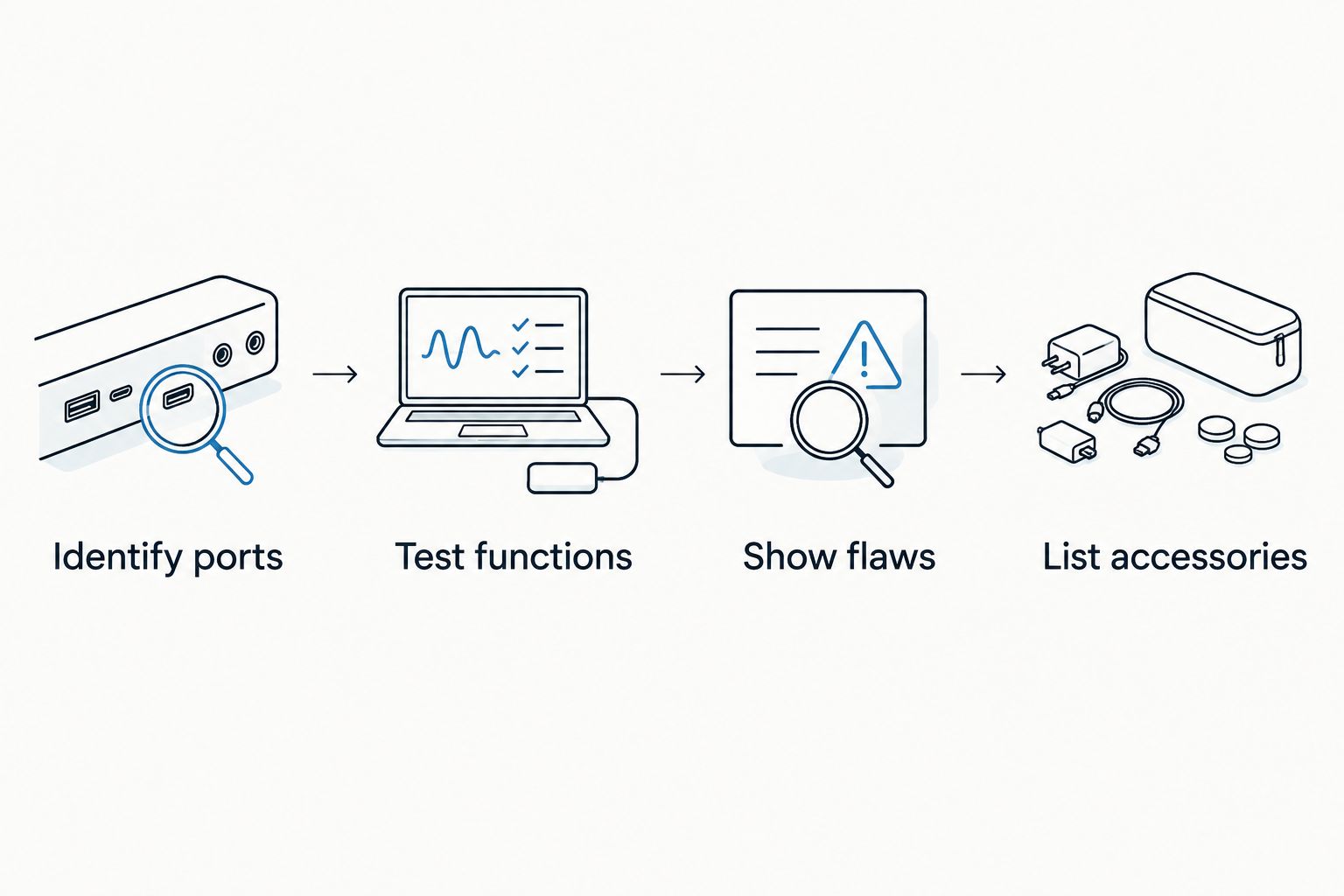
For your 2026 listing, build the description around these checks:
- Identify ports. Distinguish 6.35 mm and 3.5 mm connections. Connector size alone does not establish the signal type.
- Test functions. Describe what you actually tested. For microphones and interfaces, check whether the setup requires phantom power, commonly 48 V.
- Show flaws. Photograph wear, repairs, damaged controls, and missing parts. Separate cosmetic marks from functional problems.
- List accessories. State whether the power supply, case, cables, mounts, or other relevant parts are included.
These checks apply on both platforms. Avoid broad claims such as fully tested if you only powered the unit on. Describe the test instead. Accurate limits give a buyer more useful information than an unsupported promise.
Both need gear-specific shipping preparation
Shipping preparation is a tie: the item determines the packing job, not the marketplace. A guitar, turntable, drum, and rack unit present different risks. Treat them accordingly.
Secure loose parts. Protect controls and protruding connectors. Keep the item from moving inside its packaging. Follow applicable manufacturer guidance for equipment that needs special handling.
A buyer should also distinguish item condition from delivery arrangements. Clear photos show the equipment before shipment; they do not establish how it will be packed. Ask about packing when the item is fragile or difficult to replace.
For local handover, agree on an inspection process and suitable testing arrangements before meeting. A studio device might require cables, software, or other equipment to demonstrate its functions. Decide what a meaningful test looks like instead of discovering at collection that nobody brought the necessary power supply.
Neither platform choice removes that work. Prepare the transaction around the gear.
Pricing models: compare terms, not headline promises
The useful 2026 comparison is the fee model, not a hard-coded price list. The music-focused platform states zero seller commissions; eBay applies selling fees according to the relevant selling terms. Check the current terms before you publish.
Keep your assessment separated into practical questions:
- What marketplace charges apply to this transaction?
- What packing and delivery arrangements are required?
- Are you choosing any optional selling services?
- What responsibilities remain with you after the buyer commits?
A commission advantage is meaningful, but it is not the whole transaction. Equally, access to an auction format does not automatically justify every expense associated with a sale.
Compare like with like. Use the same item, condition description, included accessories, and delivery plan when deciding between marketplaces. Otherwise, you are comparing different offers rather than different platforms. Choose the model that fits your selling process without treating zero seller commissions as a blanket statement about every possible expense.
Final verdict: choose the workflow you actually need
Choose OohYeah if you are a music-centered seller
OohYeah wins for a musician, music store, or producer who wants zero seller commissions and a marketplace built around gear, professionals, and independent artists. Create an account. Prepare an accurate listing. Show the connections, flaws, and included accessories before asking someone to buy.
Its limitation is focus: it is not the direct match for a seller whose main requirement is handling unrelated merchandise alongside instruments.
Choose eBay if you sell across categories or need auctions
eBay wins for a mixed-inventory reseller or an instrument seller who specifically wants auction bidding. Its general category coverage and auction format address those needs directly.
Its limitation is that those features do not replace music-specific listing detail, and selling fees require review under the applicable terms. Choose the format deliberately. Do not assume a broad marketplace guarantees demand for your particular item.
List your music gear
Create an account and prepare your gear listing with zero seller commissions.
One-glance scorecard
| Dimension | Winner |
|---|---|
| Music-centered seller fit | OohYeah |
| Zero seller commissions | OohYeah |
| Auction selling | eBay |
| Mixed-category inventory | eBay |
| Hiring music professionals | OohYeah |
| Independent artist discovery and support | OohYeah |
| Verifying used-gear condition | Tie: inspect the listing |
| Shipping preparation | Tie: pack for the item |
FAQ
Is OohYeah better than eBay for selling music gear?
OohYeah is the better fit when you want music-focused selling with zero seller commissions. eBay is the better fit when you need auctions or want to sell instruments alongside unrelated merchandise.
Does zero seller commissions mean selling has no other expenses?
No. Zero seller commissions describe the marketplace commission, not every expense involved in a transaction. Review packing, delivery, and any other applicable terms separately.
Can I auction a used instrument on eBay?
Yes, eBay supports auction listings as well as fixed-price listings. Choose an auction because you want bidding, not because it guarantees a particular outcome.
Which marketplace should a music store choose in 2026?
OohYeah fits a music store that wants music-centered selling with zero seller commissions. eBay fits a store that specifically needs auction listings or broader merchandise categories.
Where should I look if I need a producer or engineer?
OohYeah includes hiring music professionals such as producers and engineers within its marketplace purpose. Define the project, inspect relevant work samples, and agree on deliverables before hiring.
What should I check before buying used studio gear?
Check the exact model, connections, working condition, power requirements, and included accessories. Ask what the seller actually tested rather than relying on a general condition label.
Which is better for independent artist discovery?
OohYeah is the direct fit because discovering and supporting independent artists is part of its stated purpose. eBay primarily supports buying and selling listed items, including music-related merchandise.
One last thing
Write the test description before you write the sales pitch. For your next 2026 listing, explain how you checked the item, which functions you confirmed, and which functions remain untested.
That changes the buyer's task from interpreting adjectives to evaluating evidence. A clear account of a noisy control, repaired joint, or missing power supply is more useful than calling the item great. Pick your marketplace, then make the individual listing earn the buyer's attention.